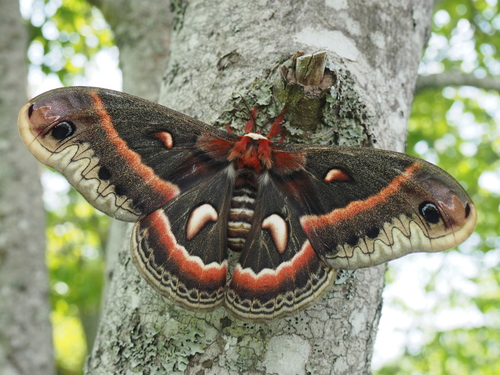
Cecropia Moth
Hyalophora cecropia
Witness the spectacular beauty of the Cecropia Moth, a nocturnal giant with a wingspan of up to seven inches. This native silk moth is a hidden gem of North American backyards, appearing only for a few short weeks each summer.
Quick Identification
Size
Wingspan 13–18 cm (5–7 inches); Body length approx. 5–6 cm (2–2.5 inches)
Colors
Rich reddish-brown wings with white, red, and black bands; distinct crescent-shaped white spots on all four wings; bright red abdomen with white stripes
Key Features
- North America's largest native moth
- Crescent-shaped white spots on wings
- Fuzzy red body with white banding
- Large, feathery antennae on males
When You’ll See Them
Geographic range
Where Does the Cecropia Moth Live?
The Cecropia Moth is a true North American giant, native to the vast deciduous landscapes of the eastern United States and Canada. Its range extends from the Atlantic coast westward to the edge of the Great Plains and occasionally into the Pacific Northwest, covering nearly two-thirds of the continent. From the lush forests of the Appalachian Mountains to suburban backyards in the Midwest, these moths are well-established wherever their favorite host trees, like maples and cherries, are found.
Basemap © OpenStreetMap contributors
Behavior
The Cecropia Moth is a master of the night, emerging from its silk cocoon in late spring or early summer with one goal: to find a mate. Because adults lack mouthparts and cannot eat, they must rely entirely on energy stored from their time as caterpillars. This gives them a very short lifespan of only 7 to 14 days, during which they are most active in the hours before dawn.
These moths are typically solitary, but males use their large, plumose (feathery) antennae to detect female pheromones from over a mile away. When not flying, they rest with their wings spread flat or tented over their backs, relying on their intricate patterns to blend into the bark of trees during the daylight hours to avoid predators like birds and squirrels.
EverydayEarth exclusive
Camera Tips
Capturing a Cecropia Moth on camera requires a bit of strategy since they are strictly nocturnal. The most effective method is to use a 'light trap' setup. Hang a white bedsheet vertically and shine a UV (blacklight) or a high-pressure mercury vapor light onto it. Position your camera about 3-5 feet away from the sheet, aimed at the center where the moths are likely to land. The white background helps the AI-powered camera focus and identify the moth’s distinct wing patterns.
Since these moths are large, ensure your camera's motion sensitivity is set to high, but be mindful of the wind blowing the sheet. A stable mounting point like a tripod or a fence post is essential. If you are using a trail camera with infrared (IR) night vision, the moth's wings will reflect the light beautifully, but a color-capable night mode will better capture their stunning red and brown hues.
Timing is everything. In most regions, Cecropia Moths emerge in late May or June. They are most active during the 'dark' hours of the night, particularly between midnight and dawn. If you find a female resting on your sheet, keep the camera rolling; she may release pheromones that attract multiple males to the area, providing a rare opportunity to document mating behavior in your own backyard.
Similar Species
Species that look similar or are commonly confused with Cecropia Moth.
Frequently Asked Questions
Record Cecropia Moth at your habitat
Connect a camera to start building your own species record — AI identifies every visitor automatically.