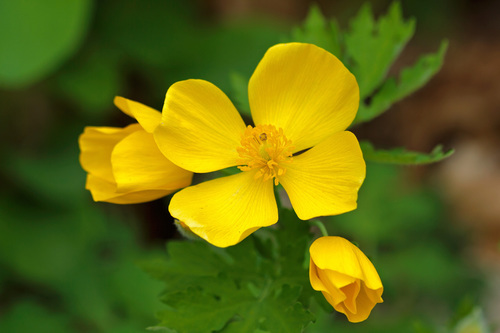
Celandine Poppy
Chelidonium diphyllum
A golden beacon of the spring woodland, the Celandine Poppy carpets forest floors with brilliant yellow blooms and distinctive oak-like foliage. This hardy native perennial is a favorite for pollinators and a must-have for any shaded backyard sanctuary.
Quick Identification
Size
Height ranges from 12 to 18 inches (30 to 45 cm); flowers are approximately 2 inches (5 cm) wide
Colors
Brilliant buttery-yellow flowers; light bluish-green to silvery-green foliage; yellow-orange sap in the stems
Key Features
- Four bright yellow petals with a dense cluster of golden central stamens
- Deeply lobed, oak-like leaves with rounded edges and pale undersides
- Hairy, nodding green seed pods that resemble small pendant lanterns
- Distinctive yellow-orange latex sap visible when stems or leaves are broken
When You’ll See Them
Geographic range
Where Does the Celandine Poppy Live?
Native to the eastern half of North America, the Celandine Poppy is most frequently found in the rich woodlands of the American Midwest and the Appalachian region. Its core range spans from western Pennsylvania and southern Michigan down to northern Alabama and Georgia, with a small, protected population extending north into southwestern Ontario, Canada. While it thrives in untouched old-growth forests, it is widely appreciated as a native ornamental and is commonly found in shaded backyard habitats across its native range.
Basemap © OpenStreetMap contributors
Behavior
The Celandine Poppy, also known as the Wood Poppy, is a quintessential spring ephemeral of the North American forest floor. It wakes up early in the year, blooming from March to June to take advantage of the sunlight reaching the ground before the large trees overhead grow their full leaves. Unlike many spring wildflowers that go dormant and disappear by summer, this poppy can keep its lush, attractive foliage throughout the season if the soil stays consistently moist.
Though it appears delicate, the plant is remarkably hardy and has developed a clever survival strategy involving local wildlife. It produces a bitter, colorful sap that makes it unpalatable to deer and rabbits, ensuring its survival in high-browse areas. Furthermore, it engages in a symbiotic relationship with ants; the seeds have a protein-rich attachment called an elaiosome that ants love to eat. Ants carry the seeds to their underground nests, consume the snack, and leave the seeds in their waste piles, effectively planting the poppy in nutrient-rich soil away from the parent plant.
EverydayEarth exclusive
Camera Tips
Capturing the Celandine Poppy on an AI-powered camera is best achieved using a timelapse setting. Because this species doesn't move across the landscape, a timelapse allows you to witness the dramatic 'sleep movements' of the plant, as the flowers open wide to greet the morning sun and nod or partially close during the night. Set your camera on a low-profile stake or tripod just 12 inches off the ground, angled slightly upward to catch the underside of the pendant seed pods and the bright faces of the blooms.
Lighting is the biggest challenge when filming these bright yellow flowers. In direct, harsh sunlight, the yellow petals can reflect too much light, causing 'clipping' in your image where detail is lost. Aim to place your camera in a spot that receives dappled light or 'bright shade.' Overcast days are actually the best for capturing the true, deep gold of the petals and the intricate textures of the lobed leaves. If your camera has a macro or close-focus mode, use it to highlight the visits of early-season pollinators like mining bees and bumblebees.
If you are looking to capture wildlife interactions, focus your lens on the base of the plant during the early summer when the seed pods begin to burst. You may be lucky enough to capture footage of ants industriously hauling the seeds away. Position the camera's motion sensor to trigger on small movements, and ensure the area around the base of the poppy is clear of tall debris or dead leaves that might obscure these tiny, fascinating 'planters' at work.
Similar Species
Species that look similar or are commonly confused with Celandine Poppy.
Frequently Asked Questions
Record Celandine Poppy at your habitat
Connect a camera to start building your own species record — AI identifies every visitor automatically.