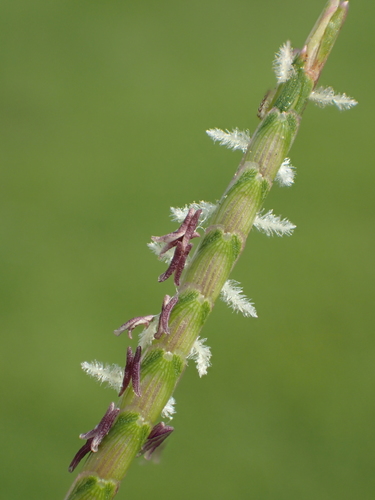
Centipede Grass
Eremochloa ophiuroides
The ultimate 'lazy man's grass,' this hardy perennial creates a lush, apple-green carpet that thrives where other plants fail. Known for its unique creeping runners, Centipede Grass is the backbone of the Southern suburban landscape.
Quick Identification
Size
Mowing height of 2.5–5 cm (1–2 inches); stolons can spread 1–2 meters (3–6 feet) per season
Colors
Distinctive apple-green foliage; purplish-green seed spikes turning tan when dry
Key Features
- Thick, creeping stolons resembling centipede legs
- Blunt, rounded leaf tips with a folded vernation
- Single-spike seed heads produced on lean stalks
- Low-growing, dense sod-forming habit
When You’ll See Them
Geographic range
Where Does the Centipede Grass Live?
Native to Southeast Asia and southern China, Centipede Grass was introduced to the United States in 1916. It has since become the dominant permanent lawn grass across the humid Southeastern United States, stretching from the Carolinas through the Gulf Coast to eastern Texas. Beyond North America, it has established populations in tropical regions of South America, Africa, and several Pacific Islands, favored for its ability to thrive in poor, sandy soils.
Basemap © OpenStreetMap contributors
Behavior
Centipede Grass is often referred to as the 'lazy man's grass' because of its exceptionally slow vertical growth and minimal nutrient requirements. Unlike aggressive turfgrasses that require constant mowing and heavy fertilization, this species focuses its energy on horizontal expansion. It spreads via thick, surface-level runners called stolons, which root at various nodes to create a dense, weed-suppressing mat that feels like a thick carpet underfoot.
In its natural cycle, the grass is highly sensitive to environmental changes. It thrives during the hot, humid summer months but enters a dormant, brown state as soon as the first frost hits. It exhibits a unique 'self-regulating' behavior where it will intentionally yellow if the soil becomes too alkaline or if it receives too much nitrogen, signaling to the homeowner that its specific acidic habitat needs are not being met.
EverydayEarth exclusive
Camera Tips
Capturing the growth of Centipede Grass requires a patience-driven approach, ideally using time-lapse photography. Set your camera on a low-profile ground stake or a mini-tripod, positioning the lens no more than 6 to 10 inches from the ground. Angle the camera slightly downward to focus on the 'terminal bud' of a stolon—the crawling tip of the grass runner. Over a period of two to three weeks in June or July, you can record the fascinating 'centipede-like' movement as the grass colonizes bare soil.
For the best visual results, ensure your camera is placed in an area that receives full morning sun. Centipede Grass has a unique 'apple-green' color that is most vibrant when backlit by the early sun, which helps distinguish it from darker weeds or neighboring Bermuda grass. Because this species grows slowly, set your time-lapse interval to one frame every 1-2 hours; this will create a smooth video showing the runners rooting into the earth and the blades unfurling.
Since AI-powered cameras rely on movement or specific shapes, you can help the identification process by keeping the area around your target patch clear of tall debris. The AI best recognizes Centipede Grass by its seed heads—the single, slender spikes that emerge in late summer. If you are trying to document the grass's health, use a camera with high color fidelity to monitor the transition from dormant brown to vibrant green in early spring, as this transition is a key indicator of local soil temperature.
Similar Species
Species that look similar or are commonly confused with Centipede Grass.
Frequently Asked Questions
Record Centipede Grass at your habitat
Connect a camera to start building your own species record — AI identifies every visitor automatically.