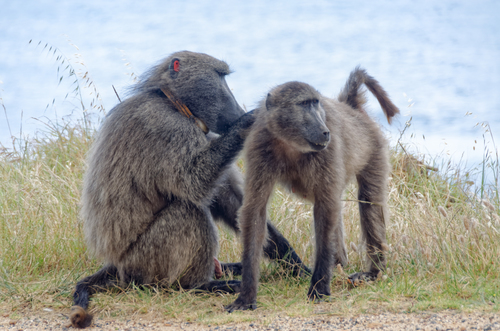
Chacma Baboon
Papio ursinus
The Chacma Baboon is the rugged socialite of the African wild, known for its incredible intelligence, dog-like muzzle, and complex troop hierarchies.
Quick Identification
Size
Body length 50-115 cm (20-45 in); weight 15-45 kg (33-100 lbs), with males twice the size of females.
Colors
Grizzled dark brown to yellowish-gray fur; blackish face and extremities; infants are born with black fur and pink faces.
Key Features
- Elongated, dog-like muzzle with powerful jaws
- Distinctive 'broken' tail carriage where the base points up and the rest hangs down
- Large, dark hairless sitting pads on the rump
- Pronounced manes and large canines in adult males
When You’ll See Them
Sightings on EverydayEarth
Jul 18, 2026
A small troop of Chacma Baboons is resting and interacting on a large grey boulder. Two adults sit close together while an energetic juvenile climbs across the rock's surface, eventually moving toward the back of the group.
Jul 9, 2026
A troop of Chacma Baboons is active on a rocky, sun-drenched hillside. In the foreground, one baboon is groomed by another before standing up and walking away. Throughout the background, several more individuals can be seen foraging among the trees and rocks. The scene is accompanied by the sound of loud barks and grunts from the troop.
Jul 8, 2026
A baboon is seen resting high in a tree at night, its body tucked securely into a fork in the branches. It remains relatively still throughout the clip, likely sleeping or resting in its nighttime roost.
Jul 8, 2026
Two baboons are perched together on a sturdy tree branch under the cover of night. They are huddled closely, likely for warmth, with one individual's profile clearly showing its characteristic elongated snout and heavy brow. The animals remain relatively still, occasionally blinking or adjusting their position as they rest.
Jul 8, 2026
A Chacma Baboon is huddled on a tree branch at night, likely sleeping. It remains mostly stationary throughout the clip, occasionally shifting its head slightly while tucked into a tight ball for warmth.
Jul 8, 2026
A troop of Chacma Baboons is moving across a rocky, sunlit hillside. One individual is partially visible in the lower right foreground, while others are seen foraging and sitting on the slope in the background.
Geographic range
Where Does the Chacma Baboon Live?
The Chacma Baboon is a quintessential resident of Southern Africa, holding a vast native range that spans from the southern tip of the continent up through the Zambezi River. They are most densely populated across South Africa, Namibia, Botswana, and Zimbabwe, with significant populations also found in southern Mozambique and parts of Angola. While they are not found outside of Africa, they are incredibly successful within their range, thriving in environments as diverse as the arid Namib Desert and the snowy peaks of the Drakensberg Mountains.
Basemap © OpenStreetMap contributors
Behavior
Chacma Baboons are highly social animals that live in organized troops led by a dominant alpha male. Their society is built on a complex web of hierarchies and 'friendships'—non-sexual bonds between males and females that provide protection for the female and her offspring. They spend their days foraging on the ground, often traveling several kilometers, but they are skilled climbers who retreat to high cliffs or tall trees at night to escape predators like leopards.
As one of the most intelligent primates in Africa, they possess a vast repertoire of vocalizations and facial expressions to communicate within the group. In areas where they overlap with humans, they have become master problem-solvers, learning to navigate suburban fences and even open car doors in search of food. Their behavior is a fascinating mix of fierce territoriality and tender social grooming, which serves to reinforce group bonds and reduce stress.
EverydayEarth exclusive
Camera Tips
Capturing Chacma Baboons on a trail camera requires a setup that is both secure and thoughtfully placed. These primates are incredibly strong and naturally curious; if they spot a camera at eye level, they may attempt to dismantle it or 'taste test' the casing. Always use a steel security housing (bear box) and mount the camera at a height of 2.5 to 3 meters, angled downward, to keep it out of their direct line of sight and reach.
Because baboons follow established daily routines, look for 'commuter paths'—well-worn tracks that lead from their sleeping cliffs or trees toward water sources or foraging grounds. Positioning your camera near a safe watering hole or a gap in a fence line is highly effective. They are most active during the morning and late afternoon, so ensure your camera's PIR sensor is optimized for daytime triggers and use a high shutter speed to capture their often-fast social interactions.
Avoid using food or aromatic lures to attract baboons. This can lead to 'food conditioning,' where baboons associate cameras or human-proximate areas with easy meals, which often results in destructive behavior or conflict. Instead, focus on natural bottlenecks in the landscape. Set your camera to 'Burst Mode' or 'Photo + Video' to capture the full troop dynamic, as you will often see the dominant males leading the group, followed by females carrying infants on their backs or bellies.
Similar Species
Species that look similar or are commonly confused with Chacma Baboon.
Frequently Asked Questions
Record Chacma Baboon at your habitat
Connect a camera to start building your own species record — AI identifies every visitor automatically.