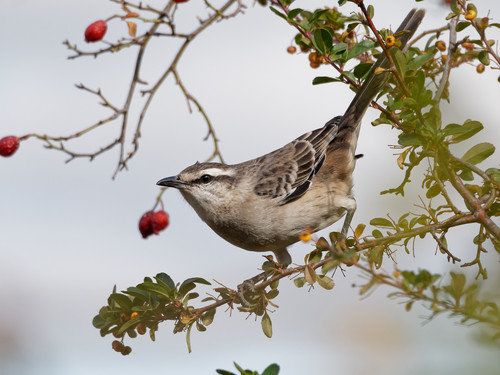
Chalk-browed Mockingbird
Mimus saturninus
A master of mimicry with a bold personality, the Chalk-browed Mockingbird is the soundtrack of South American gardens. Watch for its signature white eyebrow and acrobatic ground-hunting displays.
Quick Identification
Size
23.5-26 cm (9.2-10.2 in) long; weight 55-73 g (1.9-2.6 oz)
Colors
Grey-brown upperparts, whitish underparts, dark eye-stripe with a bold white 'brow', and white-tipped tail feathers
Key Features
- Distinctive white 'chalky' eyebrow above a dark eye-stripe
- Long, dark tail with conspicuous white outer tips
- Slightly curved black bill
- Active, upright posture when ground foraging
When You’ll See Them
Geographic range
Where Does the Chalk-browed Mockingbird Live?
The Chalk-browed Mockingbird is a quintessential South American species, native to a vast region stretching from the eastern and central plateaus of Brazil down through the grassy plains of Uruguay and Paraguay. It is a common resident across northern and central Argentina and can also be found in eastern Bolivia and southern Suriname. Because it thrives in human-altered landscapes, its range has expanded alongside agricultural and suburban development throughout the continent.
Basemap © OpenStreetMap contributors
Behavior
The Chalk-browed Mockingbird is a charismatic and highly vocal bird, legendary for its ability to mimic the songs of dozens of other species. Males are tireless performers, often perching on the highest available point—such as a rooftop, antenna, or treetop—to broadcast a complex medley of stolen melodies and original trills. This social and curious bird is often the first to investigate new objects in a garden, displaying a bold personality that makes it a favorite among backyard observers.
These birds are frequently seen on the ground, where they run with great agility rather than hopping. They often perform a unique 'wing-flashing' display, where they rhythmically open and close their wings to startle insects out of hiding. Highly territorial during the breeding season, they will fearlessly mob much larger predators, including hawks and domestic cats, to protect their nests.
EverydayEarth exclusive
Camera Tips
To capture the Chalk-browed Mockingbird on your backyard camera, focus on ground-level activity. These birds spend much of their day patrolling lawns for insects, so placing your camera 12 to 24 inches off the ground near a patch of short grass is ideal. Use a wide-angle setting if available, as they tend to move quickly and erratically while hunting. Because they are highly attracted to water, a low-profile bird bath or a ground-level dripping fountain is arguably the best 'lure' for high-quality video footage.
If you want to encourage them to stay in the frame longer, offer 'soft' treats. Unlike many garden birds, they aren't interested in hard seeds. Instead, provide halved oranges, bananas, or even a small dish of mealworms. Position the food on a flat rock or a low platform feeder. If you place the bait in a spot that receives morning sun, you'll better capture the subtle 'chalky' texture of their eyebrow and the intricate grey patterns on their wings.
During the breeding season (typically September through January), these birds become much more vocal. If your camera has a microphone, try mounting it higher up on a fence post or a trellis. They love to sing from 'sentinel' positions. A camera angled toward the top of a frequently used perch will capture their dramatic throat movements and the fanning of their white-tipped tails as they perform their complex mimicry songs.
Similar Species
Species that look similar or are commonly confused with Chalk-browed Mockingbird.
Frequently Asked Questions
Record Chalk-browed Mockingbird at your habitat
Connect a camera to start building your own species record — AI identifies every visitor automatically.