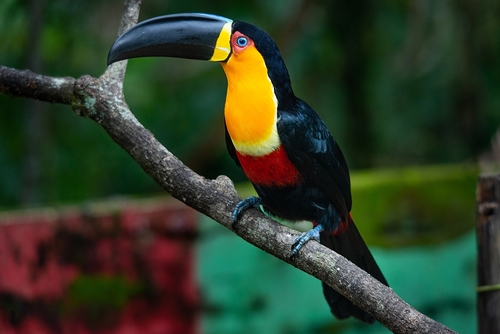
Channel-billed Toucan
Ramphastos vitellinus
With its iconic channeled bill and striking blue eye-rings, the Channel-billed Toucan is the colorful spirit of the South American canopy. A social and curious bird, it brings a prehistoric charm to any tropical backyard or forest trail.
Quick Identification
Size
46–56 cm (18–22 in) long; wingspan approx. 60 cm (24 in); weight 285–455 g (10.1–16.0 oz)
Colors
Primarily black plumage with a white or yellow throat and upper breast; bright blue skin around the eyes; black bill with a yellow or blue ridge
Key Features
- Massive black bill with a distinct lateral channel or groove
- Vibrant blue orbital skin surrounding the eye
- Striking white or yellow bib contrasting with black body
- Short, rounded wings and a long tail
When You’ll See Them
Geographic range
Where Does the Channel-billed Toucan Live?
The Channel-billed Toucan is a quintessential resident of the South American tropics, making its home across a vast expanse of the Amazon Basin and the Atlantic Forest. Its native territory stretches from the northern reaches of the Caribbean island of Trinidad and the Guianas, extending southward through Brazil and into the lowland forests of central Bolivia. In these regions, they are most frequently spotted in the lush, humid canopies where fruit is abundant and nesting sites in hollow trees are plentiful.
Basemap © OpenStreetMap contributors
Behavior
Channel-billed Toucans are highly social and intelligent birds, often traveling in small groups of 3 to 12 individuals. They are most famous for their "croaking" vocalizations, which sound more like a frog or a cicada than a typical bird song. In the canopy, they move with a characteristic hopping motion, using their massive bills with surprising dexterity to reach fruit on thin branches or to toss food items into the air before swallowing them whole.
While they are primarily fruit-eaters, these toucans are opportunistic predators and will raiding the nests of smaller birds for eggs and nestlings. They are also known to engage in "bill-fencing," a social behavior where two individuals gently clash their beaks together, which is thought to establish social hierarchy or strengthen pair bonds. Though naturally wary of humans, they can become quite bold in suburban areas near rainforests, especially if fruit trees are available.
EverydayEarth exclusive
Camera Tips
To capture the Channel-billed Toucan on camera, height is your best friend. These birds are predominantly arboreal and rarely descend to the ground. If you are monitoring a backyard or forest edge, mount your camera at least 10 to 15 feet high, angled slightly downward toward a known perching branch or a fruiting tree like a papaya, fig, or palm. Because they are large birds, ensure the camera is positioned far enough back to capture the full span of their impressive bill and tail.
Toucans are highly motivated by food, so placing a camera near a platform feeder stocked with fresh native fruits (like bananas or melon) can yield incredible close-ups. However, be mindful of local wildlife regulations regarding feeding. If you aren't using bait, focus on "corridors"—the open gaps between large trees that toucans use to fly from one feeding site to another. Their flight pattern is a distinct 'flap-and-glide' which is easy to identify on video.
For the best visual results, use a fast shutter speed or high-frame-rate video setting to catch the quick movements of their heads and bills. Early morning light provides the best illumination for the blue skin around their eyes and the texture of their bill. Since they are vocal birds, using a camera with a high-quality microphone can help you identify their presence even before they enter the frame, as their deep croaking calls carry for long distances through the forest.
Similar Species
Species that look similar or are commonly confused with Channel-billed Toucan.
Frequently Asked Questions
Record Channel-billed Toucan at your habitat
Connect a camera to start building your own species record — AI identifies every visitor automatically.