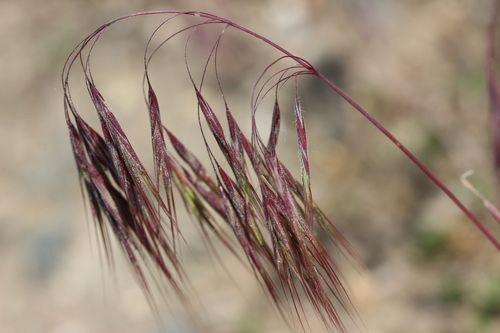
Cheatgrass
Bromus tectorum
A prolific and transformative invader, Cheatgrass reshapes entire landscapes with its rapid spring growth and vibrant purple maturity. Known for 'cheating' native plants out of water, this grass is a key player in the fire ecology of the American West.
Quick Identification
Size
10 to 60 cm (4 to 24 inches) in height
Colors
Bright green in early spring, turning reddish-purple at maturity, and straw-yellow when dry
Key Features
- Drooping, multi-branched seed heads (panicles)
- Soft, downy hairs covering the leaf blades and sheaths
- Long, needle-like awns (10-17mm) that feel sharp to the touch
- Distinctive reddish-purple hue in late spring
When You’ll See Them
Geographic range
Where Does the Cheatgrass Live?
Originally native to Europe, southwestern Asia, and northern Africa, Cheatgrass has expanded its reach across nearly every continent except Antarctica. It is most notorious in the United States, where it has become the dominant species across millions of acres in the Intermountain West and the sagebrush steppe. It is also well-established as an introduced species in Australia, New Zealand, and parts of South America, often following human-disturbed corridors and agricultural expansion.
Basemap © OpenStreetMap contributors
Behavior
Cheatgrass is a master of timing, functioning as a winter annual that germinates in the autumn or early winter whenever moisture becomes available. This early start allows it to develop a robust root system while native perennial grasses are still dormant, effectively "cheating" its neighbors out of water and nutrients when spring arrives. This aggressive growth strategy allows it to form dense monocultures that push out native biodiversity.
By early summer, the plant has already produced its seeds and died, leaving behind a thick carpet of dry, fine tinder. This dramatically increases the frequency and intensity of wildfires in the areas it inhabits. Because it matures and dries out weeks before native species, it creates a feedback loop where frequent fires kill off native shrubs like sagebrush, which are not fire-adapted, while the cheatgrass seeds survive in the soil to recolonize the charred earth even more densely.
EverydayEarth exclusive
Camera Tips
Because Cheatgrass is a plant, the most compelling way to capture it on a trail camera is through a long-term time-lapse sequence. Mount your camera on a sturdy post about 12-18 inches off the ground, angled slightly downward toward a patch of disturbed soil in late winter. Setting the camera to take one high-resolution photo every 24 hours at mid-day will allow you to create a video showing the plant's explosive growth and its dramatic color shift from emerald green to deep purple and finally to brittle gold.
If you are looking for high-quality still images, use a camera with a macro or close-focus capability. The fine, downy hairs on the leaves and the delicate structure of the drooping seed heads (panicles) are best captured in the low-angled light of the early morning. This "Golden Hour" lighting catches the light on the awns, making the entire field appear to glow. Be sure to check your camera's focus manually if possible, as the thin stalks can sometimes confuse infrared autofocus systems.
Pay close attention to seasonal timing. The most iconic "Cheatgrass look" occurs in late spring (typically May or June depending on your latitude) when the plant turns its signature reddish-purple. This phase only lasts for about two weeks before the plant dries out completely. Finally, always clean your gear and your boots after visiting a Cheatgrass-heavy site; the seeds are designed to hitchhike on fabric and can easily be spread to new areas by your camera bag or shoelaces.
Similar Species
Species that look similar or are commonly confused with Cheatgrass.
Frequently Asked Questions
Record Cheatgrass at your habitat
Connect a camera to start building your own species record — AI identifies every visitor automatically.