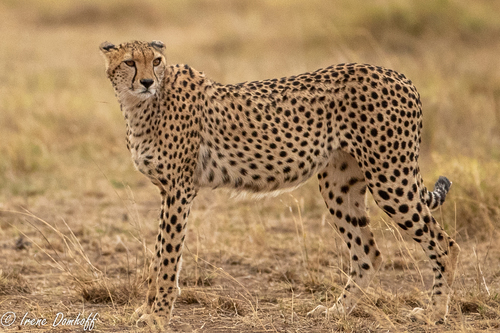
Cheetah
Acinonyx jubatus
Witness the incredible elegance of the Cheetah, the fastest land animal on the planet. Built for speed and precision, this sun-loving predator is a master of the high-speed chase across the African plains.
Quick Identification
Size
Head-and-body length 1.1–1.5 m (3.6–4.9 ft); shoulder height 67–94 cm (26–37 in); weight 21–65 kg (46–143 lbs)
Colors
Tawny to pale buff fur with evenly spaced, solid black spots; white underbelly; black 'tear' streaks running from the eyes to the mouth
Key Features
- Distinctive black 'tear' streaks on the face
- Solid black spots (unlike leopard rosettes)
- Long, slender limbs and a deep, narrow chest
- Long tail with a white-tipped tuft that acts as a rudder
When You’ll See Them
Sightings on EverydayEarth
Jul 5, 2026
A cheetah is resting in the center of a clearing, alertly turning its head to scan the area. To its right, another smaller, darker animal is lying down. On the far right edge of the frame, a large rhinoceros is resting quietly on the ground.
Jul 2, 2026
Under the cover of night, two cheetahs and a large white rhinoceros are seen resting in an open clearing. One cheetah remains alert, sitting upright and surveying the area, while its companion and the rhinoceros are bedded down nearby.
Jun 25, 2026
Two cheetahs are resting in a woodland clearing at night. One remains lying down while the other sits upright, scanning the environment with occasional head movements.
Jun 21, 2026
Two cheetahs are resting in a large dirt clearing at night. The individual in the center of the frame is awake and active, seen grooming its fur and adjusting its position, while a second cheetah remains lying still in the background to the left.
Jun 18, 2026
In the middle of the night, a cheetah is seen resting on the ground and grooming its coat. A bush duiker sits nearby, staying relatively still while the cheetah is active. Faint light streaks from insects or dust particles are visible drifting across the foreground.
Jun 18, 2026
Two cheetahs are resting on the ground in a clearing at night. They are lying down comfortably, occasionally shifting their heads to look around or grooming themselves briefly.
Geographic range
Where Does the Cheetah Live?
The cheetah is primarily native to the African continent, with its largest remaining populations found in Southern and Eastern Africa. It thrives in the vast landscapes of Namibia, Botswana, Kenya, and Tanzania, though its range is now highly fragmented compared to its historical reach. Beyond Africa, a tiny, critically endangered population of Asiatic cheetahs survives in the central plateau of Iran, making it one of the rarest cats on Earth.
Basemap © OpenStreetMap contributors
Behavior
The cheetah is a unique outlier among big cats, primarily because it is diurnal—meaning it is most active during daylight hours. This behavior likely evolved to avoid competition with larger, more aggressive nocturnal predators like lions and spotted hyenas, which frequently steal cheetah kills. They are famous for their incredible acceleration, reaching speeds over 100 km/h in short bursts of 20 to 30 seconds to overtake agile prey.
Socially, cheetahs exhibit a fascinating split. Females are generally solitary, raising their cubs alone and navigating massive home ranges that overlap with other individuals. In contrast, males often form small, permanent groups called 'coalitions,' usually consisting of brothers. These groups work together to defend territories and hunt larger prey, providing a significant survival advantage in the harsh savanna environment.
While cheetahs are naturally wary of humans, they are less aggressive than lions or leopards. In areas with high eco-tourism, they have been known to jump onto safari vehicles to get a better vantage point for spotting prey. However, they are highly sensitive to habitat fragmentation and human encroachment, often coming into conflict with livestock farmers when their natural prey becomes scarce.
EverydayEarth exclusive
Camera Tips
To capture high-quality footage of a cheetah, placement is everything. Unlike many other cats, cheetahs are highly visual and frequent high-vantage points to scout for prey. Look for 'playtrees' or 'marking trees'—sloping trees or fallen logs that allow a cheetah to climb a few feet off the ground. These are communal hubs for cheetahs; males use them to mark territory, and females use them to scan the horizon. Mounting your camera 3-5 feet high, angled toward these landmarks, is a winning strategy.
Since cheetahs are diurnal, you don't need to rely heavily on infrared night vision. In fact, settings that prioritize high frame rates (60fps or higher) during the day are ideal. This allows you to capture the fluid, athletic movement of the cat without motion blur. Because cheetahs have incredible eyesight, ensure your camera is well-camouflaged and the 'no-glow' LEDs are covered if you are using them at dawn or dusk, as the faint red glow can sometimes startle them.
If you are setting a camera in a wide-open area, try to find a 'scent post.' Cheetahs frequently visit termite mounds or prominent rocks to leave scent marks. Positioning your camera about 10-15 feet away from these landmarks will give you a full-body profile shot. Avoid using meat-based baits, as these will more likely attract hyenas or lions which may damage your equipment or drive the cheetah away. Instead, focus on natural corridors between water sources and high-ground vantage points.
Similar Species
Species that look similar or are commonly confused with Cheetah.
Frequently Asked Questions
Record Cheetah at your habitat
Connect a camera to start building your own species record — AI identifies every visitor automatically.