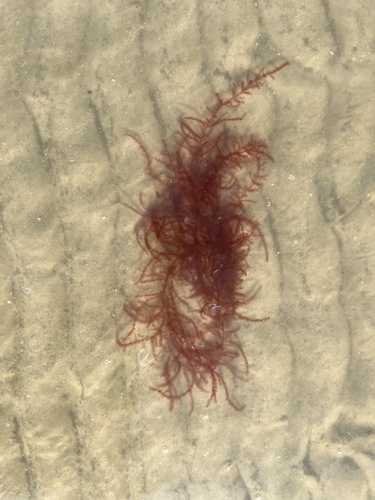
Chenille Weed
Dasya pedicellata
A masterpiece of marine lace, Chenille Weed transforms the shallows into a vibrant crimson garden. Its soft, pipe-cleaner fronds sway gracefully with the tide, providing a vital nursery for the ocean's smallest inhabitants.
Quick Identification
Size
Fronds typically range from 10–60 cm (4–24 inches) in length, with delicate filaments only a few millimeters thick.
Colors
Brilliant crimson, rosy pink, or deep purplish-red; may bleach to a pale yellow or white if exposed to excessive sunlight or when dying.
Key Features
- Densely branched stems covered in soft, hair-like filaments
- Pipe-cleaner or 'chenille' appearance when submerged
- Anchored by a small, disk-shaped holdfast
When You’ll See Them
Geographic range
Where Does the Chenille Weed Live?
Chenille Weed is primarily native to the temperate and subtropical waters of the North Atlantic Ocean. It is a common sight along the eastern seaboard of the United States and Canada, and its range extends across the ocean to the Mediterranean Sea and the coasts of the United Kingdom and Western Europe. While its core population is Atlantic-based, it has also been observed in some Caribbean waters and as an introduced species in various global shipping ports.
Basemap © OpenStreetMap contributors
Behavior
Chenille Weed is a sophisticated red macroalga that exhibits a fascinating growth pattern driven by the rhythm of the tides and the intensity of the sun. Unlike many coarser seaweeds, its structure is incredibly delicate, composed of a central axis densely clothed in fine, pigment-rich hairs. These hairs maximize the surface area for nutrient absorption and photosynthesis in the often-turbid waters of the coastal shelf.
While it remains anchored to one spot, Chenille Weed is far from static. It moves constantly with the surge and flow of the ocean, creating a hypnotic waving motion that provides both aeration for the plant and a dynamic hunting ground for small marine creatures. It often acts as a seasonal pioneer species, appearing rapidly in the spring as water temperatures rise and providing an immediate spike in the complexity of the local underwater landscape.
EverydayEarth exclusive
Camera Tips
Capturing the ethereal beauty of Chenille Weed requires an underwater camera setup, such as a waterproof action camera or a specialized marine housing for your trail cam. To get the most natural footage, mount the camera to a stable underwater structure—like a dock piling, a heavy rock, or a weighted tripod—at a depth of 1 to 3 feet during low tide. This ensures the plant remains submerged while still receiving enough natural sunlight to illuminate its vibrant red pigments.
Lighting is the biggest challenge when photographing red algae like Chenille Weed. Because water absorbs red light waves first, the deeper you go, the more the plant will look brown or grey. For the best results, use a 'red filter' on your lens or position an external underwater LED light at a 45-degree angle to the plant. This will restore its natural rosy hue and highlight the fine, lace-like details of its filaments that are often lost in ambient light.
AI-powered cameras can be tricky with seaweed because the constant swaying motion caused by current often triggers 'motion detected' alerts. To avoid a memory card full of empty water videos, set your camera to a time-lapse mode rather than motion trigger. A photo every 30 to 60 seconds over a full tidal cycle will create a stunning visual narrative of how the weed expands and contracts with the water movement. If you are using motion detection, lower the sensitivity and focus the 'detection zone' on a stable object nearby, like a rock or a shell.
For a unique 'wildlife' angle, use a macro lens or a close-up setting. Chenille Weed is a favorite hiding spot for 'sea-monsters' in miniature, such as skeleton shrimp, sea slugs, and juvenile pipefish. Positioning your camera just 6 inches away from a healthy frond can reveal a hidden world of biodiversity that uses the weed as a nursery. Early morning or late afternoon sun can also provide a beautiful backlighting effect through the translucent red fibers.
Frequently Asked Questions
Record Chenille Weed at your habitat
Connect a camera to start building your own species record — AI identifies every visitor automatically.