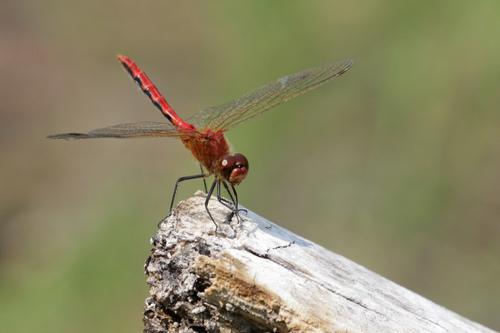
Cherry-faced Meadowhawk
Sympetrum internum
A vibrant crimson hunter of the late summer, the Cherry-faced Meadowhawk adds a splash of brilliant red to northern wetlands and backyards. These agile dragonflies are the garden's best defense against mosquitoes, patrolling the air with unmatched precision.
Quick Identification
Size
21–36 mm (0.83–1.42 in) in length with a wingspan of approximately 45–55 mm
Colors
Mature males and females have a deep cherry-red abdomen and face. Both sexes feature black triangle markings on the sides of the abdomen and solid black legs.
Key Features
- Distinctive cherry-red face when mature
- Black triangle-shaped markings along the sides of the abdomen
- Solid black legs without lighter stripes
- Small-bodied percher usually found on low vegetation
When You’ll See Them
Geographic range
Where Does the Cherry-faced Meadowhawk Live?
The Cherry-faced Meadowhawk is native to the northern half of North America. Its primary range extends across the northern and central United States and throughout most of Canada, reaching as far north as the southern Yukon and Northwest Territories. It is a common sight in the Great Lakes region and the Pacific Northwest, appearing in high densities where permanent wetlands meet open grasslands or suburban yards.
Basemap © OpenStreetMap contributors
Behavior
They are particularly fond of basking in the sun to regulate their body temperature, often positioning their bodies to maximize sun exposure on cool autumn mornings. While they are territorial, they are less aggressive than larger species, often congregating in large numbers in meadows or near pond edges during the peak of the breeding season in late summer.
EverydayEarth exclusive
Camera Tips
Since these are small insects, use a camera with a close-focusing distance or a macro lens. If using a standard trail camera, set it to its highest resolution and use a high-speed trigger. Because they return to the same perch repeatedly, you have multiple chances to get the shot. Position your camera so the sun is behind it or to the side; this highlights the translucent wings and makes the 'cherry' red of their body pop against the background.
Environmental lures are more effective than food. A small water feature or birdbath will attract them, but the best way to keep them in frame is to provide a wind-sheltered, sun-drenched spot. Dragonflies are cold-blooded, so they will seek out the warmest parts of your garden during the morning. Setting your camera to record short video clips (5-10 seconds) is often better than still photos, as it allows you to capture their rapid take-offs and landings.
Similar Species
Species that look similar or are commonly confused with Cherry-faced Meadowhawk.
Ruby Meadowhawk
Nearly identical, but the Ruby Meadowhawk often has a slightly lighter face and different subtle patterns on its underside.
White-faced Meadowhawk
Easily distinguished by its stark, creamy-white face which contrasts sharply with its red body.
Saffron-winged Meadowhawk
Identified by the yellow or 'saffron' wash along the leading edges of its wings and its yellowish-brown legs.
Frequently Asked Questions
Record Cherry-faced Meadowhawk at your habitat
Connect a camera to start building your own species record — AI identifies every visitor automatically.