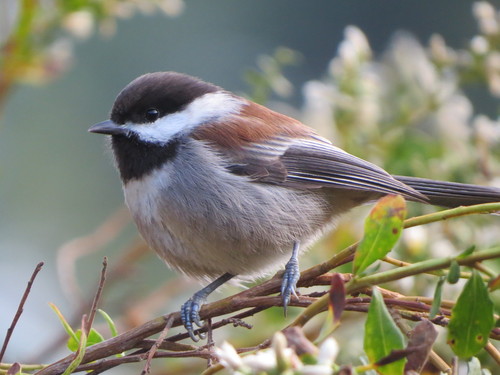
Chestnut-backed Chickadee
Poecile rufescens
The Chestnut-backed Chickadee is a tiny, russet-colored acrobat that brings life to the evergreen forests of the Pacific Coast. Known for its bold personality and distinctive reddish plumage, it is a quintessential backyard visitor for Western bird enthusiasts.
Quick Identification
Size
Length: 11.5–12.5 cm (4.5–4.9 in); Wingspan: 18–19 cm (7.1–7.5 in); Weight: 7–12 g (0.25–0.42 oz)
Colors
Rich chestnut-brown back and flanks; dark sooty-brown cap and throat bib; bright white cheek patches; light gray-white underbelly.
Key Features
- Rich chestnut-colored back and flanks
- Sooty-black cap and throat bib
- Bright white cheek patches
- Short, dark bill and acrobatic hanging posture
When You’ll See Them
Geographic range
Where Does the Chestnut-backed Chickadee Live?
Native to the Pacific Northwest region of North America, the Chestnut-backed Chickadee thrives along a lush coastal strip extending from southern Alaska through British Columbia and down into central California. It also maintains significant inland populations in the humid forests of northern Idaho and northwestern Montana. Unlike many songbirds, this species is a dedicated year-round resident, rarely migrating far from its home territory even in the coldest months.
Basemap © OpenStreetMap contributors
Behavior
The Chestnut-backed Chickadee is an exceptionally social and energetic bird, often seen clinging upside down to the tips of evergreen branches. They are highly acrobatic foragers, moving with a restless intensity as they glean insects from bark and needles. During the non-breeding season, they frequently lead mixed-species foraging flocks, serving as sentinels for kinglets, nuthatches, and creepers.
In backyard settings, these chickadees are notably bold and curious. They are often the first birds to discover a new feeder and are known for their 'tse-et' calls and buzzy 'chick-a-dee' vocalizations. Unlike some more skittish songbirds, they often tolerate human presence at close range, making them a favorite for backyard birdwatchers and photographers alike.
EverydayEarth exclusive
Camera Tips
To capture high-quality images of the Chestnut-backed Chickadee, focus your camera on high-traffic areas like tube feeders filled with black oil sunflower seeds or suet cages. These birds are extremely fast, so set your AI-powered camera to its highest shutter speed or 'Sports' mode to avoid motion blur. If your camera has a 'Photo Burst' or 'Multi-shot' setting, enable it; chickadees rarely stay still for more than a second, and a rapid sequence is the best way to catch that perfect mid-air or hanging pose.
Position your camera roughly 5 to 6 feet (1.5–1.8 meters) off the ground, aiming at a specific 'perch' near the feeder—like a lichen-covered branch—rather than the feeder itself. These birds prefer to land on a nearby branch to survey the area before grabbing a seed. This results in much more natural-looking wildlife photography compared to shots of birds on plastic equipment. A side-on angle is best to showcase the distinctive chestnut coloring on their backs, which is their most defining feature.
Water is another fantastic lure. A heated birdbath in the winter or a dripping water feature in the summer will attract them reliably. Because they are year-round residents, you can capture different 'looks' throughout the seasons, from them puffing their feathers in the snow to the sleeker appearance of the breeding season. For the best lighting, face your camera north or south to avoid the harsh glare of direct rising or setting sun, which can wash out the subtle browns and whites of their plumage.
Similar Species
Species that look similar or are commonly confused with Chestnut-backed Chickadee.
Black-capped Chickadee
Lacks the rich reddish-brown back, featuring a slate-gray back instead.
Mountain Chickadee
Identified by a distinct white line (eyebrow) above the eye and a grayer overall appearance.
Boreal Chickadee
Has a brown cap rather than a black/sooty cap and is found much further north and east.
Frequently Asked Questions
Record Chestnut-backed Chickadee at your habitat
Connect a camera to start building your own species record — AI identifies every visitor automatically.