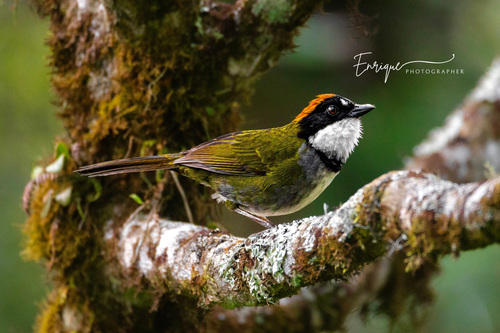
Chestnut-capped Brushfinch
Arremon brunneinucha
A vibrant gem of the Neotropical undergrowth, the Chestnut-capped Brushfinch is famous for its bold 'red-headed' appearance and secretive nature. Often found scurrying through the leaves of misty cloud forests, this bird is a favorite for backyard birders in high-altitude regions.
Quick Identification
Size
Length: 17–19 cm (6.7–7.5 in); Weight: 30–45 g (1.1–1.6 oz)
Colors
Rich chestnut-rufous crown and nape, black face mask with small white spots on the forehead, bright white throat patch, and moss-green upperparts. Underparts are primarily gray with white in the center of the belly.
Key Features
- Bold chestnut-red crown and nape
- High-contrast white throat patch bordered by a black band
- Sharp black mask across the eyes and cheeks
- Olive-green back and wings
- Two small white spots on the forehead just above the beak
When You’ll See Them
Geographic range
Where Does the Chestnut-capped Brushfinch Live?
This striking bird is native to the Americas, stretching from the mountainous regions of central Mexico down through Central America into the northern Andes of South America. Its core range includes the highlands of Guatemala, Costa Rica, Panama, and Colombia, eventually reaching as far south as southern Peru and east into Venezuela. In these regions, it is a permanent resident, favoring the lush, moist environments of high-elevation 'sky islands.'
Basemap © OpenStreetMap contributors
Behavior
The Chestnut-capped Brushfinch is a master of the forest floor, spending most of its time hopping through dense undergrowth and leaf litter. While they can be shy and are often heard before they are seen, they are not particularly fearful of humans if approached quietly. They are typically found in pairs or small family units, communicating with high-pitched, thin "seep" calls that pierce through the humid air of the cloud forest.
These birds are highly terrestrial and rarely fly long distances, preferring to scurry away into the brush when disturbed. Their social life is characterized by strong pair bonds, and they are frequently seen foraging together, tossing leaves aside with their stout bills to uncover hidden prey. Unlike some other tropical birds, they don't typically join large mixed-species foraging flocks, preferring the privacy of their own territory.
EverydayEarth exclusive
Camera Tips
To capture the Chestnut-capped Brushfinch on camera, you must focus on the 'ground-level' view. Because these birds spend the vast majority of their time foraging in leaf litter, mounting your camera just 6 to 12 inches off the ground is ideal. Point the lens toward a natural clearing in the undergrowth or along a well-trodden forest trail where the ground is relatively flat and free of tall grass that might trigger the motion sensor in the wind.
While we don't recommend artificial baits in sensitive ecosystems, you can naturally attract them by creating a 'leaf litter pile.' Raking together a small patch of damp leaves and mulch in front of your camera provides a perfect foraging spot for them to hunt for insects. Placing your camera near a shallow, ground-level water source like a small puddle or a dripping mossy rock is also highly effective, as these birds are frequent bathers.
For camera settings, use a fast shutter speed or a high-frame-rate video mode. Brushfinches are incredibly twitchy and move with quick, jerky hops; standard settings often result in motion blur. Since they inhabit the dark, shaded understory of the forest, ensure your camera has good low-light performance or set the ISO slightly higher to compensate for the dim canopy light. Early morning, just as the sun begins to penetrate the upper branches, is the golden hour for capturing their vibrant chestnut caps.
Similar Species
Species that look similar or are commonly confused with Chestnut-capped Brushfinch.
Frequently Asked Questions
Record Chestnut-capped Brushfinch at your habitat
Connect a camera to start building your own species record — AI identifies every visitor automatically.