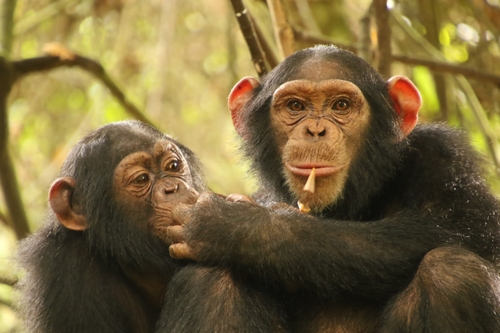
Chimpanzee
Pan troglodytes
Meet our closest living relatives, the brilliant and social architects of the African rainforest. From intricate tool use to complex community life, the chimpanzee offers a fascinating window into the natural world.
Quick Identification
Size
Height: 1-1.7 m (3.3-5.6 ft); Weight: 32-70 kg (70-154 lbs)
Colors
Coarse black hair covering the body; bare face, palms, and soles range from pale pink to dark brown or black
Key Features
- Opposable thumbs and big toes for precision gripping
- Large, prominent ears and pronounced brow ridges
- Robust, muscular build with arms longer than legs
- Lack of a tail, characteristic of great apes
When You’ll See Them
Geographic range
Where Does the Chimpanzee Live?
Native to the lush belt of equatorial Africa, the chimpanzee's range stretches from the western shores of Senegal through the dense central jungles to the edge of the Albertine Rift in Tanzania and Uganda. These great apes primarily inhabit the rainforests and savannah-woodlands of countries like the Democratic Republic of the Congo, Gabon, and Cameroon, which hold the largest remaining populations. While their historical range once spanned twenty-five countries, they now exist in increasingly fragmented pockets across the continent's tropical heart.
Basemap © OpenStreetMap contributors
Behavior
Chimpanzees are renowned for their complex social structures, living in multi-male, multi-female communities that can number over 100 individuals. Within these groups, they form intricate alliances and maintain a strict hierarchy, often communicating through a sophisticated system of vocalizations, facial expressions, and grooming rituals. They are one of the few species known to create and use tools, such as using sticks to fish for termites or stones to crack open nuts.
While primarily arboreal when feeding or nesting, they spend significant time on the ground walking on their knuckles. They are highly territorial and can be aggressive toward rival groups, but they also show remarkable empathy and cooperation within their own community. Interactions with humans are complex; while they are generally wary, habitat encroachment has led to increased conflict in some regions, making conservation efforts vital for their survival.
EverydayEarth exclusive
Camera Tips
Capturing chimpanzees on camera requires a deep understanding of their travel routes and social hubs. Because they move both on the ground and in the canopy, trail cameras should be positioned at chest height (about 3-4 feet) along established forest paths or 'chimp highways.' These paths are often identifiable by knuckle-print tracks or discarded fruit husks. Ensure the camera is securely strapped to a sturdy tree, as curious juveniles are known to investigate and even dismantle equipment; using a protective steel lockbox is highly recommended.
Angle your camera slightly downward to catch the details of their facial features and tool-use behaviors. Avoid using white-flash cameras, as the bright light can startle the group and may lead them to avoid the area in the future; high-quality no-glow infrared (Black IR) is the industry standard for great ape research to ensure their natural behavior isn't interrupted. If you are monitoring a fruiting tree, place the camera 15-20 feet back to capture the full range of movement as individuals descend and ascend.
Timing is crucial; chimpanzees are most active during the early morning and late afternoon as they move between nesting sites and feeding grounds. In areas with high human activity, they may become more elusive, so placing cameras near remote water sources or salt licks during the dry season can yield spectacular results. Always check for local regulations and ethical guidelines, as chimpanzees are highly sensitive to human presence and potential disease transmission.
Similar Species
Species that look similar or are commonly confused with Chimpanzee.
Frequently Asked Questions
Record Chimpanzee at your habitat
Connect a camera to start building your own species record — AI identifies every visitor automatically.