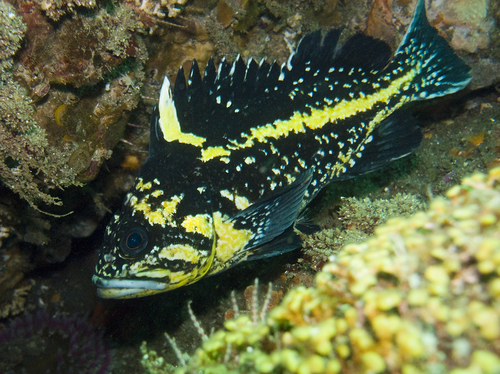
China Rockfish
Sebastes nebulosus
Defined by its bold golden stripe and stoic personality, the China Rockfish is a masterpiece of the Pacific reef. This long-lived, solitary resident is a crown jewel for underwater observers and a testament to the vibrant biodiversity of our coastal waters.
Quick Identification
Size
Typically 30-45 cm (12-18 inches) in length; weighing up to 1.8 kg (4 lbs)
Colors
Deep blue-black or dark mottled brown body with a vivid, broad yellow stripe and scattered yellow spots on the face and fins
Key Features
- Continuous yellow stripe from the third dorsal spine to the tail
- Deep blue-black or brownish-black base color
- Prominent venomous dorsal spines
- Solitary and sedentary posture on rocks
When You’ll See Them
Geographic range
Where Does the China Rockfish Live?
The China Rockfish is native to the cold, nutrient-rich temperate waters of the Eastern Pacific Ocean. Its range extends along the western coast of North America, stretching from the Gulf of Alaska near Kodiak Island southward to San Miguel Island in southern California. They are most commonly encountered in the rugged, rocky subtidal zones of British Columbia, Washington, and Oregon, where the complex seafloor provides ample shelter.
Basemap © OpenStreetMap contributors
Behavior
The China Rockfish is a quintessential homebody of the Pacific reef. Unlike many other rockfish species that school in mid-water, the China Rockfish is strictly solitary and highly territorial. It selects a specific rock crevice or small cave as its 'home base' and may remain within a few meters of this spot for years, if not its entire adult life. They are often seen resting their pectoral fins directly on the substrate, appearing almost like statues among the sponges and anemones.
These fish are relatively docile but will defend their preferred hideouts from other rockfish. Their interaction with humans is mostly limited to encounters with scuba divers and anglers. Because of their sedentary nature and striking coloration, they are a favorite subject for underwater photographers. While they are slow-growing and long-lived—reaching ages of up to 79 years—they are vulnerable to localized overfishing due to their refusal to migrate to new territories.
EverydayEarth exclusive
Camera Tips
Capturing the China Rockfish requires a specialized underwater setup, as these fish reside in the subtidal zone. Use a weighted underwater housing or a dedicated marine trail camera placed near high-relief rocky structures or the entrance of small caves. Because this species is extremely territorial and sedentary, once you locate a 'home crevice,' you can be almost certain the fish will return to that exact frame. Position your camera at a 45-degree angle to the reef face to capture both the fish's profile and its striking yellow lateral stripe.
Lighting is the most critical factor at the depths these fish inhabit. Natural red light is absorbed quickly in the water column, making the fish appear dull and grey. Utilize external waterproof LED panels or strobes to bring out the brilliant yellow and deep indigo hues. Set your camera to a wide-angle focal length, as visibility in temperate Pacific waters can be limited; getting closer to the subject reduces the amount of 'marine snow' or particulate matter between the lens and the fish.
For the best results, deploy your camera during periods of low swell and slack tide to ensure maximum water clarity. If your camera supports it, use a motion-trigger setting with a high sensitivity, as these fish often move in slow, deliberate bursts. A 20-second video clip is often more rewarding than a still photo, as it captures the flare of their spiny dorsal fins and their unique 'hovering' swimming style. Baiting with a small, perforated container of chopped herring or squid can draw the fish out from deep within a crevice into your lighting field.
Similar Species
Species that look similar or are commonly confused with China Rockfish.
Black-and-yellow Rockfish
Lacks the continuous yellow lateral stripe, featuring isolated yellow spots instead.
Gopher Rockfish
Has light-colored spots on a darker brown background rather than a bold yellow stripe.
Quillback Rockfish
Features much longer dorsal spines and a mottled brown/orange appearance without the distinct yellow stripe.
Frequently Asked Questions
Record China Rockfish at your habitat
Connect a camera to start building your own species record — AI identifies every visitor automatically.