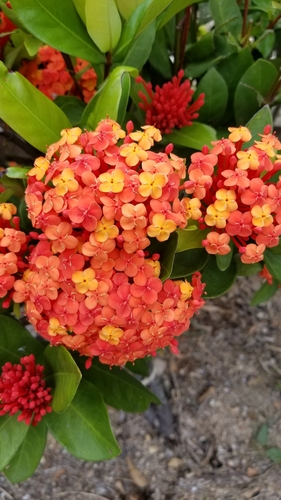
Chinese Ixora
Ixora chinensis
A cornerstone of the tropical garden, the Chinese Ixora is a 'jungle flame' that attracts a revolving door of butterflies and hummingbirds. Its dense, glossy foliage and fire-colored blooms make it the perfect natural stage for backyard wildlife photography.
Quick Identification
Size
A medium-sized shrub reaching 1–2 meters (3.3–6.6 ft) in height with a spread of 0.6–1.2 meters (2–4 ft).
Colors
Brilliant orange-red to scarlet flower clusters; leathery, dark glossy green foliage; occasionally found in pink or yellow cultivated varieties.
Key Features
- Large, flat-topped flower clusters (corymbs) with dozens of small, four-petaled florets
- Glossy, elliptical leaves arranged in opposite pairs along woody stems
- Deeply tubular flowers that hold nectar at the base
- Evergreen habit with dense, bushy growth.
When You’ll See Them
Geographic range
Where Does the Chinese Ixora Live?
Chinese Ixora is native to the warm, humid environments of Southeast Asia, with its core range encompassing southeastern China, Indochina, and the Philippines. Due to its popularity as an ornamental shrub, it has been widely introduced and naturalized throughout the global tropics, including the southern United States (specifically Florida), the Caribbean, and parts of Central and South America. It thrives in USDA zones 10-11, where frost is rare and humidity remains high throughout the year.
Basemap © OpenStreetMap contributors
Behavior
Chinese Ixora serves as a vibrant, stationary hub of activity in the backyard ecosystem. While the plant itself is a slow-growing evergreen, its lifecycle is defined by its near-constant production of nectar-rich blossoms. In tropical and subtropical climates, it blooms year-round, acting as a reliable food source for a wide variety of long-tongued pollinators. It is particularly responsive to sunlight, with the most prolific flowering occurring in plants situated in full-sun positions.
Beyond its role as a nectar producer, the dense, multi-stemmed structure of the Chinese Ixora provides vital architectural support for wildlife. The thick foliage offers excellent thermal cover and protection from predators for small reptiles like anoles and geckos. For humans, it is a hardy and non-invasive garden companion that requires little more than acidic soil and consistent pruning to maintain its shape, making it a favorite for hedges and privacy screens.
EverydayEarth exclusive
Camera Tips
When using an AI camera to monitor a Chinese Ixora, think of the plant as a 'stage' rather than the subject itself. Position your camera on a tripod or mount it approximately 2 to 3 feet away from a large, healthy flower cluster. Aim for a side-angle or 45-degree downward view to capture butterflies and hummingbirds as they hover or land on the flat-topped blossoms. Because the flowers are a brilliant, saturated red, midday sun can cause 'clipping' or blown-out colors in your footage; if possible, position the camera so the plant is back-lit during the golden hours of morning or late afternoon for the most dramatic shots.
Since the primary visitors to Ixora are fast-moving insects and birds, you should set your camera's motion trigger sensitivity to 'High.' This ensures the AI captures the rapid arrival of a Swallowtail butterfly or a Sulphur before they fly off to the next cluster. If your camera allows for it, increase the shutter speed to at least 1/500th of a second to freeze the motion of wings. Using a 'Macro' or 'Close-up' focus mode is ideal here, as the most interesting action happens right at the mouth of the tubular florets.
Keep an eye on the leaves in your camera's field of view as well. Many AI cameras are trained to spot larger animals, but the dense interior of an Ixora bush is a prime spot for lizards and spiders. If you notice a specific branch is a frequent resting spot for a lizard, adjust your frame to include that branch. During the rainy season, these plants become even more attractive to wildlife, so ensure your camera lens is clean and treated with a water-repellent coating to capture the clear, vibrant colors of the wet petals and the creatures they attract.
Frequently Asked Questions
Record Chinese Ixora at your habitat
Connect a camera to start building your own species record — AI identifies every visitor automatically.