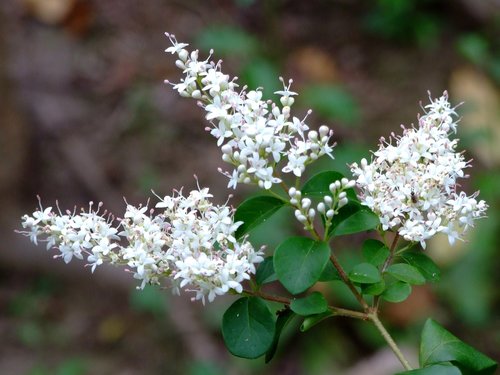
Chinese privet
Ligustrum sinense
A fragrant invader that has redefined the American landscape, Chinese privet is a master of survival. Its dense green thickets provide a year-round backdrop for backyard wildlife while challenging native ecosystems.
Quick Identification
Size
A multi-stemmed shrub or small tree growing 2–5 meters (7–16 feet) tall, occasionally reaching 7 meters (23 feet) in ideal conditions.
Colors
Glossy dark green leaves with lighter undersides; panicles of tiny, creamy-white flowers; fruit that matures from green to a waxy blue-black or dull purple.
Key Features
- Opposite, simple leaves with a hairy midrib on the underside
- Densely branched, semi-evergreen foliage that creates thickets
- Small, four-petaled white flowers with a heavy, sweet fragrance
- Clusters of small blue-black drupes that persist through winter
When You’ll See Them
Geographic range
Where Does the Chinese privet Live?
Originally native to the temperate and subtropical regions of East Asia, including China, Taiwan, and Vietnam, Chinese privet was widely exported as an ornamental shrub. It has since established massive invasive populations throughout the eastern and southern United States, ranging from the Gulf Coast up to New England and west to Texas. It is also found as a naturalized or invasive species in parts of Australia, New Zealand, and several island nations in the Atlantic and Pacific.
Basemap © OpenStreetMap contributors
Behavior
In suburban environments, it often goes unnoticed until it reaches a significant height, hiding in fencerows and neglected corners. While its dense structure provides excellent nesting cover for some birds, its presence often lowers the overall biodiversity of an area. The plant is semi-evergreen, meaning it retains its leaves in milder winters, giving it a competitive head start on photosynthesis in early spring before native deciduous plants have leafed out.
Despite its invasive nature, it remains popular in some traditional settings for its fragrant spring blooms. However, the sheer volume of pollen it produces can be a significant irritant for allergy sufferers. Its berries are a primary food source for wintering birds like Cedar Waxwings, which ironically aids the plant's spread as the birds deposit seeds far from the parent plant.
EverydayEarth exclusive
Camera Tips
If your camera has a time-lapse feature, use it to document the 'privet push' in early spring. By taking one photo every 4–6 hours, you can create a stunning visual record of how this plant leafs out faster than almost any other shrub in the forest. For the best color accuracy in your photos, try to orient the camera facing north or south to avoid the 'blown out' look of direct morning or evening sunlight hitting the glossy leaves.
In winter, Chinese privet is one of the few plants that provides a green background in many temperate regions. Use this to your advantage by setting up your camera to face a privet thicket; the green leaves will provide a beautiful contrast for brown-furred animals like deer or rabbits passing in front of it. Ensure your infrared (IR) settings are optimized, as the waxy surface of the leaves can sometimes reflect IR light, causing a glare in nighttime shots. Aiming the camera at a 45-degree angle to the foliage, rather than head-on, can help minimize this reflection.
Frequently Asked Questions
Record Chinese privet at your habitat
Connect a camera to start building your own species record — AI identifies every visitor automatically.