Chinook Salmon
Oncorhynchus tshawytscha
The undisputed 'King' of the Pacific Northwest, the Chinook Salmon is famous for its massive size and one of the most grueling migrations in the animal kingdom.
Quick Identification
Size
Typically 60-90 cm (24-36 in) and 4.5-22.7 kg (10-50 lbs), though record individuals reach 150 cm (58 in) and 61 kg (135 lbs).
Colors
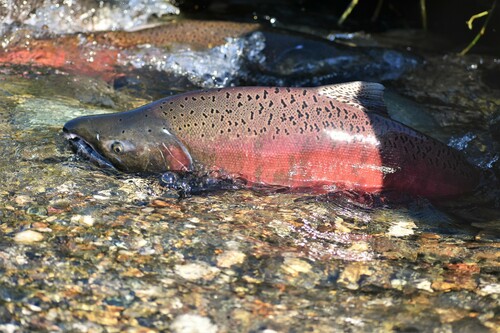
Adults are silvery with blue-green backs and black spots on the back and tail; spawning adults turn olive-brown, copper, or dull red.
Key Features
- Distinctive black gums and mouth lining
- Small black spots covering both the upper and lower lobes of the tail
- Large, robust body with a streamlined shape
- Spawning males develop a prominent hooked snout called a kype
When You’ll See Them
Geographic range
Where Does the Chinook Salmon Live?
Native to the North Pacific Ocean, Chinook Salmon inhabit a vast arc from the coast of central California up through the Pacific Northwest and Alaska to the Bering Strait. On the Asian side of the Pacific, they are found from the Kamchatka Peninsula in Russia down to northern Japan. Beyond their native range, they have been successfully introduced to the Great Lakes of North America and the rivers of New Zealand's South Island, where they have established thriving wild populations.
Basemap © OpenStreetMap contributors
Behavior
Chinook Salmon are legendary for their anadromous life cycle, meaning they are born in freshwater, migrate to the ocean to mature, and return to their natal streams to spawn. They are powerful swimmers capable of leaping over waterfalls and traveling thousands of miles against heavy currents. As semelparous animals, they give all their energy to a single spawning event, dying shortly after laying and fertilizing their eggs in gravel nests called redds.
During their time in the ocean, they are primarily solitary hunters, but they congregate in massive numbers at river mouths during seasonal migrations. Their behavior is heavily influenced by water temperature and flow levels. To humans, they are both a vital cultural symbol for Indigenous peoples and a highly prized species for commercial and recreational fishing, often referred to as 'King Salmon' due to their size and strength.
EverydayEarth exclusive
Camera Tips
Capturing Chinook Salmon requires a specialized approach, as they are primarily underwater. For the best results, use a waterproof action camera or a trail camera inside a high-quality underwater housing. Focus your efforts on shallow gravel beds (redds) in rivers during the peak spawning season. Position the camera on a weighted tripod or strapped to a heavy rock, angling it slightly upward toward the water's surface to capture the salmon as they move through the current.
If you are filming from above the water using a bridge or bank-mounted camera, a circular polarizing filter is essential. This filter cuts through the surface glare and reflections, allowing the camera to see into the water. Look for 'choke points' in the river, such as small waterfalls or narrow channels, where salmon are forced to leap or congregate while waiting for the right flow conditions.
In backyard settings near streams, timing is everything. Monitor local 'fish counts' or river flow gauges; salmon often move in pulses following a heavy rain that raises the water level. Set your camera to high-frame-rate video (60fps or higher) to capture the incredible power of their leaps in slow motion. Since spawning activities can happen around the clock, ensure your camera has high-quality infrared LEDs for night recording without spooking the fish.
Similar Species
Species that look similar or are commonly confused with Chinook Salmon.
Frequently Asked Questions
Record Chinook Salmon at your habitat
Connect a camera to start building your own species record — AI identifies every visitor automatically.