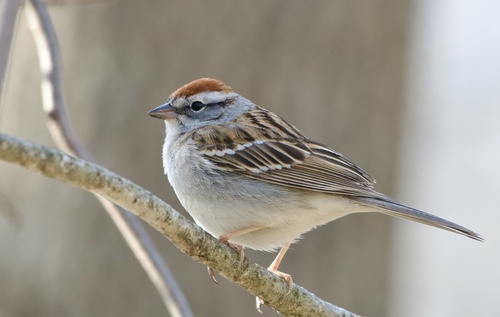
Chipping Sparrow
Spizella passerina
Recognizable by its jaunty rusty cap and crisp white eyebrow, the Chipping Sparrow is a delightful and tame visitor to North American gardens. Often seen hopping across lawns, this tiny triller brings a touch of woodland charm to every backyard.
Quick Identification
Size
Length: 4.7–5.9 in (12–15 cm); Wingspan: 8.3 in (21 cm); Weight: 0.39–0.56 oz (11–16 g)
Colors
Breeding adults feature a bright rufous (rusty) crown, a crisp white eyebrow, and a sharp black line through the eye. The breast is a smooth, unstreaked pearl-gray.
Key Features
- Bright rufous crown during breeding
- Bold black line through the eye
- Unstreaked gray-white breast and underparts
- Long, slightly notched tail
When You’ll See Them
Sightings on EverydayEarth
Jul 3, 2026
A Chipping Sparrow lands on the white feeder tray, hopping around to inspect the surface for seeds before quickly departing.
Jul 3, 2026
A Chipping Sparrow is seen landing on the feeder tray. It hops around, inspecting the surface for seeds while showing its distinctive reddish crown and dark eye-stripe. After a few seconds of exploration, it takes flight.
Jun 30, 2026
A Chipping Sparrow perches briefly on the rim of the feeder, displaying its bright rufous cap and distinct facial markings, before hopping into the tray and quickly fluttering away.
Jun 30, 2026
A Chipping Sparrow lands on the feeder tray, hopping around to forage for seeds. It displays its characteristic streaked back and dark eye-stripe as it searches the tray before flying away.
Jun 27, 2026
A Chipping Sparrow hops onto the feeder tray to forage for seeds before flying away a moment later.
Jun 27, 2026
A female Northern Cardinal and a Chipping Sparrow are perched on the feeder tray together. The sparrow briefly searches for seeds before flying away, while the cardinal remains, moving closer to the lens to feed and look around. The morning light clearly illuminates the red plumage on the cardinal's wings and crest.
Geographic range
Where Does the Chipping Sparrow Live?
Native to the North American continent, the Chipping Sparrow maintains a vast range that spans from the boreal forests of northern Canada and Alaska down through the contiguous United States. During the winter, northern populations migrate into the southern United States, Mexico, and northern Central America, including countries like Guatemala and Honduras. Because they favor open areas and suburban landscapes, they are one of the most widely distributed and easily spotted sparrows in North American residential areas.
Basemap © OpenStreetMap contributors
Recorded on EverydayEarth
Behavior
Chipping Sparrows are the archetypal 'friendly' garden bird, often appearing remarkably tame around humans. They are most frequently observed on the ground, where they move with a series of quick, energetic hops while searching for seeds. Unlike many skulking sparrow species that prefer thick brush, 'Chippies' are comfortable in open spaces like manicured lawns and short-grass parks.
During the spring, males are highly vocal, perching on exposed branches or even man-made structures like fence posts to belt out their rapid, mechanical trill. They are socially monogamous during the breeding season but transition into loose, communal flocks during the autumn and winter. These flocks often join other species, such as Juncos or Bluebirds, to forage together for safety.
EverydayEarth exclusive
Camera Tips
To capture the best footage of Chipping Sparrows, place your camera very low to the ground. These birds are dedicated ground foragers, so a camera mounted on a stake just 6 to 12 inches high, angled slightly upward, will provide an intimate perspective of their hopping behavior. Look for patches of bare earth near garden borders or under bird feeders where they naturally congregate to glean fallen seeds.
While they are frequent visitors to bird feeders, they often prefer to eat what has fallen on the ground rather than landing on the feeder itself. To lure them directly into your camera's frame, scatter small seeds like white proso millet or hulled sunflower 'hearts' (which are easier for their small bills to handle). Providing a shallow, ground-level birdbath is another excellent way to attract them, as they are frequent bathers and will often visit water sources during the heat of the day.
Because Chipping Sparrows are small and move with quick, jerky motions, set your camera to a fast shutter speed or a high frame rate to avoid motion blur. A 'burst mode' or 'photo+video' setting is ideal, as it allows you to capture their rapid head movements and the detail of their rufous crowns. Early morning light (the 'golden hour') is particularly effective for highlighting the warm tones of their plumage.
In terms of seasonality, the most striking images are captured in the spring when their breeding plumage is at its peak. During late summer, you may catch 'family groups' where duller, streaky-breasted juveniles follow their parents across the lawn. Ensure your camera is placed in an area with 'edge' cover nearby—such as a shrub or low-hanging branch—so the birds feel safe enough to linger in front of the lens.
Similar Species
Species that look similar or are commonly confused with Chipping Sparrow.
Frequently Asked Questions
Record Chipping Sparrow at your habitat
Connect a camera to start building your own species record — AI identifies every visitor automatically.