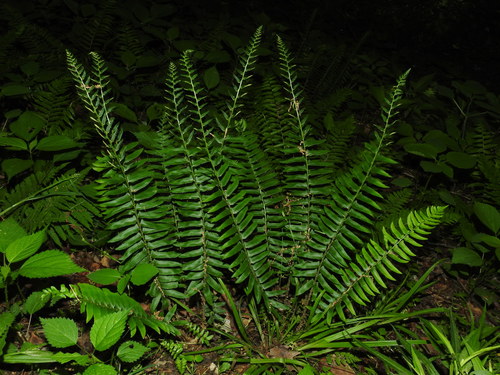
Christmas fern
Polystichum acrostichoides
A hardy icon of the eastern woodlands, the Christmas fern provides a splash of vibrant green even in the depths of winter. Its distinctive 'stocking-shaped' leaflets and clump-forming habit make it a favorite for both hikers and backyard naturalists.
Quick Identification
Size
Fronds typically range from 30 to 80 cm (12 to 31 inches) in length and 5 to 12 cm (2 to 5 inches) in width.
Colors
Glossy, deep forest green fronds with silvery-gray or light brown scales along the central stem (stipe).
Key Features
- Pinnae (leaflets) shaped like a Christmas stocking or a hilted sword
- Evergreen fronds that remain green through winter
- Fertile pinnae at the frond tip are significantly smaller than sterile ones
- Clumping growth habit without spreading runners
When You’ll See Them
Geographic range
Where Does the Christmas fern Live?
Native to the eastern half of North America, the Christmas fern thrives across a massive expanse from Nova Scotia and New Brunswick in Canada, westward to Minnesota, and south into eastern Texas and northern Florida. It is most densely concentrated in the Appalachian region and the mixed deciduous forests of the Eastern United States, where it serves as a foundational species for woodland ecosystems. While it is primarily found in its native North American range, it is also a popular choice in temperate shade gardens globally.
Basemap © OpenStreetMap contributors
Behavior
The Christmas fern is a sturdy, clump-forming perennial known for its resilience and year-round presence in the forest understory. Unlike many other ferns that wither at the first frost, this species remains vibrant green throughout the winter months, often flattening against the ground as the season progresses. This flattening behavior serves an ecological purpose, as the heavy, evergreen fronds help trap leaf litter and organic matter, which protects the plant’s crown and prevents soil erosion on the steep slopes where it often grows.
Ecologically, the Christmas fern acts as a vital sanctuary for ground-dwelling wildlife. During the harsh winter, its thick, low-lying fronds provide thermal cover and protection from predators for small mammals, amphibians, and ground-feeding birds. While it is not a primary food source for large herbivores like deer—who generally find the foliage unpalatable—it supports a variety of specialized insects and serves as a host plant for several moth species.
EverydayEarth exclusive
Camera Tips
When setting up a trail camera to capture the beauty of the Christmas fern, placement is everything. Position your camera at a low 'frog’s-eye' angle (about 6–12 inches off the ground) to emphasize the radial symmetry of the fronds. Because these ferns are stationary, they provide an excellent opportunity to use time-lapse mode; set your camera to take one photo every few days from late October through January to document the dramatic 'flattening' process as the fronds react to freezing temperatures.
Lighting is your biggest challenge in the shady woodland habitats where these ferns thrive. If possible, aim the camera toward a spot where dappled sunlight hits the glossy fronds during the golden hour (late afternoon). This highlights the waxy texture and the silvery scales on the stems. Avoid using a heavy flash at night, as the reflective surface of the evergreen leaves can cause significant 'white-out' or glare in your images; instead, rely on high-quality infrared settings if you are hoping to catch wildlife interacting with the plant.
The Christmas fern is a magnet for ground-dwelling animals during the winter months when other cover is scarce. To capture wildlife activity, focus your lens on a large, established clump of ferns near a water source or a fallen log. During the spring, look for the 'fiddleheads' (emerging coiled fronds) covered in silvery scales. Setting your camera to a short-distance macro focus if available can capture the intricate details of these emerging fronds as they unfurl—a process that happens relatively quickly over a few weeks in April or May.
Similar Species
Species that look similar or are commonly confused with Christmas fern.
Western Sword Fern
Very similar stocking-shaped leaflets but much larger, reaching up to 6 feet, and native to the Pacific Coast.
Ostrich Fern
Much larger and taller with a feather-like shape; unlike the Christmas fern, it dies back completely in the winter.
Marginal Wood Fern
Also evergreen, but the leaflets lack the 'stocking' thumb at the base and the sori (spores) are located specifically on the edges of the leaflets.
Frequently Asked Questions
Record Christmas fern at your habitat
Connect a camera to start building your own species record — AI identifies every visitor automatically.