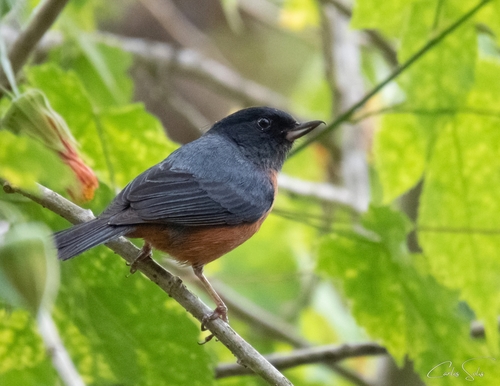
Cinnamon-bellied Flowerpiercer
Diglossa baritula
Meet the clever "nectar thief" of the highlands, known for its rich rufous belly and a specialized bill that unlocks floral treats. A common yet captivating visitor to mountain gardens from Mexico to Honduras.
Quick Identification
Size
10-12 cm (4-4.7 in) in length; 7-11 g (0.25-0.39 oz) in weight
Colors
Males have slate-blue upperparts and rich cinnamon-rufous underparts. Females are olive-brown above with buffy-cinnamon bellies.
Key Features
- Distinctive hooked bill with a sharp upturned tip
- Deep cinnamon or rufous-colored belly in males
- Slate-blue/gray back and head
- Quick, jerky movements while feeding
- Active 'nectar-stealing' behavior at flower bases
When You’ll See Them
Geographic range
Where Does the Cinnamon-bellied Flowerpiercer Live?
This small highland specialist is native to North and Central America, spanning a rugged territory from the mountains of Mexico down through Guatemala and El Salvador into western Honduras. Within its range, it is primarily found in the cool, misty altitudes of the Sierra Madre and the Central American volcanic cordillera. It is a resident species, meaning it stays in these mountainous regions year-round rather than migrating long distances to follow the seasons.
Basemap © OpenStreetMap contributors
Behavior
The Cinnamon-bellied Flowerpiercer is a fascinating "nectar thief." Unlike hummingbirds that typically pollinate flowers while feeding, this bird uses its highly specialized hooked bill to pierce the base of tubular flowers. It then laps up the nectar through the hole, bypassing the reproductive parts of the plant entirely. This behavior makes them a common sight in highland gardens where they often compete aggressively with hummingbirds for access to high-energy floral resources.
These birds are generally solitary or found in pairs, moving through the mid-to-upper levels of shrubs and trees with a nervous, twitchy energy. While they are bold when defending a feeding territory, they can be elusive when not feeding. Their social interactions are often marked by sharp, high-pitched "chip" calls used to warn off rivals or other nectar-seekers from a prized patch of blossoms.
EverydayEarth exclusive
Camera Tips
To capture the Cinnamon-bellied Flowerpiercer on camera, focus your lens on high-energy nectar sources rather than open ground. Place your camera 3 to 5 feet off the ground, aimed directly at clusters of tubular flowers like Salvia, Fuchsia, or Cuphea. Because these birds are "piercers," they often approach the flower from the side or base. Angle your camera to capture the profile of the plant rather than just the front of the blossom; this provides the best chance of seeing their unique hooked bill in action.
If you use a bird feeder, these birds are rarely interested in seeds but may occasionally visit nectar feeders designed for hummingbirds. Positioning a camera near a hummingbird feeder with a perching rail can work, but for the most natural behavior, stick to flowering shrubs. Use a high shutter speed or a camera with a fast trigger (under 0.5 seconds), as their movements are rapid and jerky. Setting your camera to "Burst Mode" or "Photo + Video" is highly recommended to catch the split-second moment they pierce a flower.
Since they are highland residents, morning light is often diffused by mountain mist, which provides excellent, soft lighting for photography. The birds are most active just after sunrise when nectar levels are at their highest. Ensure your camera is set to a higher sensitivity (ISO) if you are under a thick forest canopy. Avoid using a flash if possible, as it can startle these fast-moving birds; instead, rely on the natural activity peaks during mid-morning when the sun provides the best illumination for their rich cinnamon-colored bellies.
Similar Species
Species that look similar or are commonly confused with Cinnamon-bellied Flowerpiercer.
Slaty Flowerpiercer
The Slaty Flowerpiercer is entirely slate-gray (male) or brownish (female) and lacks the rich cinnamon/rufous belly of the Cinnamon-bellied variety.
Slate-throated Redstart
Larger with a bright red or orange belly, white outer tail feathers, and a standard straight warbler bill rather than a hooked one.
Frequently Asked Questions
Record Cinnamon-bellied Flowerpiercer at your habitat
Connect a camera to start building your own species record — AI identifies every visitor automatically.