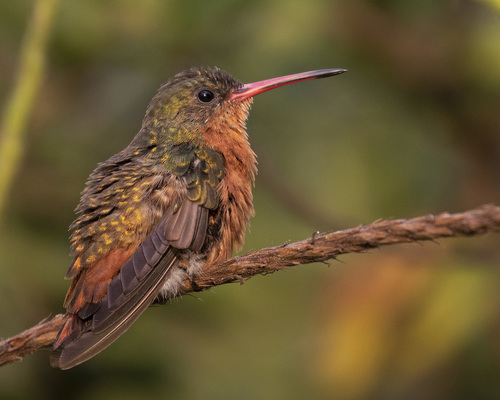
Cinnamon Hummingbird
Amazilia rutila
A warm-hued gem of the dry tropics, the Cinnamon Hummingbird is as bold as it is beautiful. Found from Mexico to Costa Rica, this fiery-bellied bird is a favorite for backyard observers and garden photographers alike.
Quick Identification
Size
9.5–11.5 cm (3.7–4.5 in) in length; weight ranges from 4 to 6 grams (0.14–0.21 oz)
Colors
Metallic bronze-green upperparts and crown; rich, uniform cinnamon or rufous-orange underparts; bill is primarily reddish-pink with a small black tip. Males and females look nearly identical.
Key Features
- Distinctive cinnamon-orange belly and breast
- Bright reddish bill with a black tip
- Metallic golden-green back and wings
- Square-ended tail with rufous highlights
When You’ll See Them
Geographic range
Where Does the Cinnamon Hummingbird Live?
The Cinnamon Hummingbird is a vibrant resident of North and Central America, thriving primarily along the Pacific slope and the Yucatan Peninsula. Its native range extends from the Sinaloa region of western Mexico southward through Belize, Guatemala, and Honduras, reaching its southern limit in northwestern Costa Rica. While it is a lowland specialist, it is highly successful in modified landscapes, making it one of the most common hummingbirds seen by residents in coastal Mexican and Central American towns.
Basemap © OpenStreetMap contributors
Behavior
The Cinnamon Hummingbird is a remarkably bold and territorial species, often acting as the 'boss' of the backyard feeder. Despite its small size, it will aggressively defend its favorite nectar sources from larger birds and even other hummingbirds, using a series of sharp, chipping calls to warn off intruders. Unlike many other hummingbirds that exhibit extreme sexual dimorphism, both males and females share the same warm, glowing plumage.
These birds are highly adapted to human presence and are frequent visitors to suburban gardens and parks within their range. They spend a significant portion of their day 'trap-lining'—visiting a series of specific flowers in a predictable circuit—but they will happily settle in a yard that provides a consistent supply of sugar water or native blooms. When not feeding, they can be seen perching on high, exposed twigs to survey their territory.
EverydayEarth exclusive
Camera Tips
To capture the Cinnamon Hummingbird on camera, your best bet is a feeder-mounted setup or a camera placed near high-nectar plants like Firebush (Hamelia patens). Because these birds are so territorial, they often have a 'favorite' perch nearby—usually a thin, bare branch with a clear view of the feeder. Placing your camera 3-5 feet away from such a perch can yield stunning, still portraits that show off the metallic green of their backs.
Hummingbirds move incredibly fast, so for clear shots, you need a camera with a high trigger speed and a short detection lag. If you are using an AI-powered camera, ensure the 'Bird' detection mode is active. Position the camera facing North or South to avoid the harsh glare of the tropical sun, which can wash out the delicate cinnamon colors of their breast. Early morning light (the 'golden hour') is particularly effective at making their rufous feathers glow.
If you are setting up a trail camera near flowers, try to pre-focus the lens on a specific bloom cluster. Using a macro lens attachment if available can make a world of difference. For bait, stick to a standard 4:1 water-to-sugar ratio in a clean, red-colored feeder. Avoid red dyes, as the bird's natural attraction to the color of the feeder itself is sufficient. In dry seasons, adding a small water mister or dripper nearby can also attract them for unique bathing shots.
Similar Species
Species that look similar or are commonly confused with Cinnamon Hummingbird.
Buff-bellied Hummingbird
Has a green throat and breast that contrasts with a buffy belly, whereas the Cinnamon is cinnamon-colored from the chin down.
Rufous Hummingbird
Smaller with a dark bill; typically has a white patch on the upper breast which the Cinnamon Hummingbird lacks.
Berylline Hummingbird
Has much more green on the breast and underparts, with cinnamon restricted mostly to the wings and lower belly.
Frequently Asked Questions
Record Cinnamon Hummingbird at your habitat
Connect a camera to start building your own species record — AI identifies every visitor automatically.