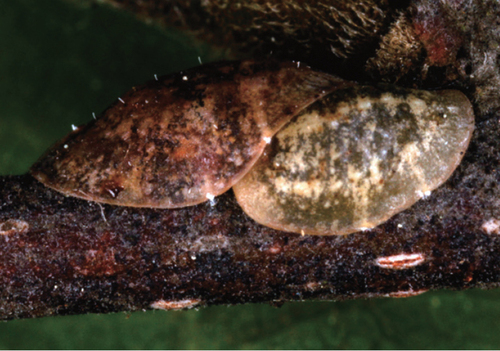
citricola scale
Coccus pseudomagnoliarum
The citricola scale is a master of camouflage, masquerading as a simple bump on a citrus twig. Despite its small size, this fascinating insect orchestrates a complex backyard drama involving sugary honeydew and protective ant guards.
Quick Identification
Size
Adult females are 4–7 mm (0.15–0.28 inches) long; nymphs are much smaller, often less than 1 mm
Colors
Mottled gray, yellowish-brown, or dusky gray; younger nymphs are translucent or pale yellow
Key Features
- Oval, slightly convex body shape
- Mottled gray or 'salt and pepper' appearance on adults
- Commonly found on the undersides of citrus leaves and green twigs
- Produces clear, sticky honeydew droplets
When You’ll See Them
Geographic range
Where Does the citricola scale Live?
Originally native to East Asia, particularly Japan and China, the citricola scale has traveled across the globe via the fruit trade. It is now a common inhabitant of Mediterranean climates, with significant populations established in the Mediterranean basin, South Africa, and Australia. In North America, it is most frequently encountered in the agricultural regions and suburban backyards of California's Central Valley and southern coastal regions.
Basemap © OpenStreetMap contributors
Behavior
These insects are famous for their waste product: honeydew. As they consume massive amounts of plant sap, they excrete a sugary liquid that coats the leaves below them. This honeydew is a prized resource for local ant colonies, which will often 'farm' the scales, protecting them from predatory ladybugs and wasps in exchange for the sweet treat. Humans often first notice the scale's presence not by seeing the insects themselves, but by the black sooty mold that grows on the accumulated honeydew.
EverydayEarth exclusive
Camera Tips
Lighting is a critical factor for these insects since they typically live in the shade of the tree canopy. A small LED light panel or a dedicated macro ring light will help highlight the subtle features of their shells. Try to angle your light from the side rather than head-on; this 'raking light' will create shadows that emphasize the convex shape of the scale, making it much easier for AI software to identify the species correctly. Early morning light is often the best natural light, as it is soft and reduces the harsh reflections off the waxy surface of citrus leaves.
While the scales themselves are static, you can capture a great deal of 'action' by focusing on their biological neighbors. Set your camera to video mode or a high-frequency time-lapse to record the interaction between ants and the scales. Ants are very active around these insects, constantly moving to collect honeydew and warding off potential predators. This provides a dynamic element to your footage and illustrates the complex ecosystem centered around a single leaf.
During the spring hatch (typically May or June), you may be lucky enough to capture the 'crawlers.' These are the only mobile stage of the insect's life. While they look like tiny moving dust motes to the naked eye, a high-magnification macro setup can reveal their movement across the leaf. This is a rare and rewarding sight for backyard wildlife enthusiasts, showing the beginning of a new generation.
Similar Species
Species that look similar or are commonly confused with citricola scale.
Frequently Asked Questions
Record citricola scale at your habitat
Connect a camera to start building your own species record — AI identifies every visitor automatically.