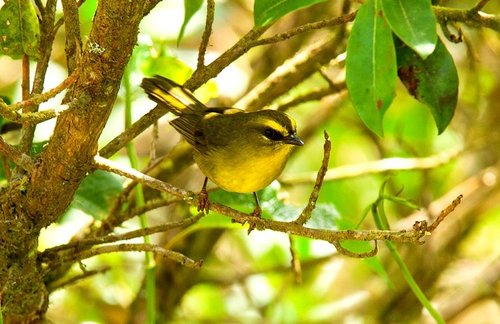
Citrine Warbler
Myiothlypis luteoviridis
A vibrant gem of the high Andes, the Citrine Warbler illuminates the misty cloud forests with its brilliant yellow plumage. This active insect-hunter is a favorite for birders exploring the high-altitude bamboo thickets of South America.
Quick Identification
Size
Length: 13.5–14.5 cm (5.3–5.7 in); Weight: 13–16 g (0.45–0.56 oz)
Colors
Olive-green upperparts with bright lemon-yellow underparts; features a prominent yellow eyebrow (supercilium) and a dark dusky line through the eye.
Key Features
- Bold yellow eyebrow (supercilium)
- Bright yellow underparts with olive-green upperparts
- Lack of wing bars or tail spots
- Active, jerky foraging movements in the understory
When You’ll See Them
Geographic range
Where Does the Citrine Warbler Live?
Native to the South American continent, the Citrine Warbler is a quintessential Andean specialist. Its range follows the spine of the Andes mountains, stretching from western Venezuela through the high-elevation corridors of Colombia, Ecuador, and Peru, finally reaching its southern limit in Bolivia. It thrives in the moist, misty environments of the subtropical and tropical montane zones, rarely descending into the lowlands.
Basemap © OpenStreetMap contributors
Behavior
The Citrine Warbler is a bundle of energy, rarely staying still as it flits through the dense understory and mid-story of Andean cloud forests. Unlike many shy forest birds, it is quite active and inquisitive, often following mixed-species foraging flocks where it hunts alongside tanagers and other warblers. It has a distinctive way of moving, often cocking its tail slightly or flicking its wings while searching for prey among the foliage.
While primarily a bird of the deep forest, they are known to venture into scrubby edges and dense bamboo thickets, especially Chusquea bamboo. They aren't particularly afraid of humans but are well-camouflaged in the dappled sunlight of the canopy, making them more often heard than seen. Their song is a series of high-pitched, thin whistles that often descend in pitch, used to defend territories in the misty highlands.
EverydayEarth exclusive
Camera Tips
To capture the Citrine Warbler on camera, placement is everything. Since these birds are understory specialists that rarely venture to the forest floor, mount your AI-powered camera at eye level (about 1.5 to 2 meters high). Aim the lens at dense vegetation or the edges of bamboo thickets, where they are most active. Because they move quickly and erratically, use a fast shutter speed or high-frame-rate video mode to avoid motion blur and catch their characteristic wing-flicks.
In a backyard or garden setting near montane forests, a misting water feature or a shallow birdbath elevated off the ground can be an irresistible draw. These warblers love to bathe in the cool mountain mist. Positioning your camera near a reliable water source during the mid-morning hours (8 AM to 11 AM) provides the best opportunity for clear, stationary shots while they preen. Ensure the background is somewhat clear so the AI can easily identify the bird's bright yellow features against the greenery.
Avoid using traditional birdseed bait, as Citrine Warblers are strictly insectivorous and won't be interested in grain. Instead, focus on 'natural lures' like native flowering shrubs that attract small insects. If you are in a cloud forest zone, look for areas with moss-covered branches; the warblers frequently glean insects from these surfaces. Setting your camera to trigger on small movements is vital, as these birds are tiny and may only stay in the frame for a few seconds.
Similar Species
Species that look similar or are commonly confused with Citrine Warbler.
Frequently Asked Questions
Record Citrine Warbler at your habitat
Connect a camera to start building your own species record — AI identifies every visitor automatically.