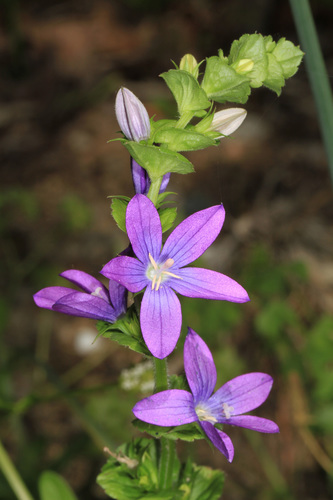
clasping Venus's looking glass
Triodanis perfoliata
A charming native wildflower with brilliant star-shaped violet blossoms and unique leaves that wrap around the stem like a protective shell.
Quick Identification
Size
Height ranges from 10 to 60 cm (4 to 24 inches); flowers are approximately 1.5 to 2 cm (0.6 to 0.8 inches) in diameter.
Colors
Brilliant violet to deep blue-purple flowers; bright green foliage with occasional reddish tints on the stem.
Key Features
- Heart-shaped leaves that clasp the stem completely
- Star-shaped violet flowers with five pointed petals
- Stiffly erect, hairy stems that rarely branch
When You’ll See Them
Geographic range
Where Does the clasping Venus's looking glass Live?
Native to the vast majority of the Americas, the clasping Venus's looking glass claims a home that stretches from the southern provinces of Canada, across nearly every state in the contiguous United States, and down through Mexico into the temperate regions of South America, including Argentina. Beyond its native haunts, this resilient wildflower has successfully naturalized in parts of China, Korea, and Australia, often hitching a ride in seed mixes or soil. It is a highly adaptable species, comfortably colonizing everything from pristine prairies to the cracks in a suburban sidewalk.
Basemap © OpenStreetMap contributors
Behavior
Clasping Venus's looking glass is a fascinating annual wildflower that employs a dual-flowering strategy. Early in the season, the plant produces small, inconspicuous flowers near the base that never open; these are 'cleistogamous,' meaning they self-pollinate internally to ensure seed production regardless of insect activity. As the season progresses and the plant grows taller, it produces the showy, open violet flowers that most observers recognize, which are designed to attract pollinators like small bees and flies.
In a backyard setting, this plant is a pioneer species, often appearing in areas where the soil has been recently disturbed or where the grass is kept thin. It is largely non-aggressive and provides an important nectar source for native pollinators during the late spring and early summer. Because it is an annual, its presence in your yard may shift from year to year as seeds are dispersed by the wind or ground-dwelling insects.
EverydayEarth exclusive
Camera Tips
Capturing the clasping Venus's looking glass requires a different approach than filming mobile wildlife. Since the plant won't trigger a standard PIR motion sensor, use your camera’s 'Time-Lapse' mode. Set the interval to one photo every 15 to 30 minutes during daylight hours. This will allow you to create a stunning video of the flowers opening as the sun hits them and following the light throughout the day.
For the best visual results, mount your camera on a low-profile stake just 6 to 12 inches off the ground. Aim for a side-profile shot to capture the unique way the leaves 'clasp' the stem, which is the plant's most identifying feature. If your camera has a macro lens or a close-focus setting, use it; the intricate veins on the violet petals and the tiny white centers are spectacular when seen up close.
Position the camera so the sun is behind it or to the side; direct midday sun can wash out the deep violet hues of the petals. Late afternoon 'golden hour' light is ideal for highlighting the fine hairs on the stem. If you want to see who is visiting your Venus's looking glass, set the camera to a high-sensitivity video mode during the peak blooming hours of 10 AM to 2 PM to catch native sweat bees and hoverflies in action.
Similar Species
Species that look similar or are commonly confused with clasping Venus's looking glass.
Frequently Asked Questions
Record clasping Venus's looking glass at your habitat
Connect a camera to start building your own species record — AI identifies every visitor automatically.