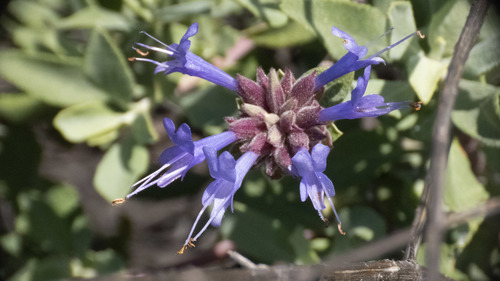
Cleveland Sage
Salvia clevelandii
A sensory masterpiece of the California chaparral, Cleveland Sage delights both humans and hummingbirds with its electric blue blooms and intoxicatingly sweet aroma. This drought-tolerant shrub is a must-have for any backyard wildlife sanctuary.
Quick Identification
Size
Grows 3 to 4.5 feet (0.9 to 1.4 meters) tall with a similar spread of 3 to 4 feet (0.9 to 1.2 meters).
Colors
Ashy gray-green foliage with vibrant amethyst-blue to violet-purple flowers.
Key Features
- Intensely fragrant peppery-sweet scent
- Stacked spherical whorls of tubular flowers
- Rugose (wrinkled) silver-gray evergreen leaves
- Square stems typical of the mint family
When You’ll See Them
Geographic range
Where Does the Cleveland Sage Live?
Cleveland Sage is a native specialist of the southwestern North American coast. It is primarily found in the foothills and coastal mountains of Southern California, specifically San Diego and Riverside counties, and extends southward into northern Baja California, Mexico. This species is perfectly adapted to the Mediterranean climate of the Pacific coast, thriving in the rugged terrain between the ocean and the inland deserts.
Basemap © OpenStreetMap contributors
Behavior
Cleveland Sage is a cornerstone of the Mediterranean-style garden and the California wildlands. As a perennial shrub, it exhibits a distinct seasonal rhythm, exploding into a vibrant display of blue-purple blooms in the late spring and early summer. It is famously drought-tolerant, entering a semi-dormant state during the hottest months of the year to conserve water, though it retains its aromatic silver foliage year-round.
This plant acts as a social hub for local biodiversity. It is highly attractive to hummingbirds, which are its primary pollinators, as well as a wide variety of native bees and butterflies. While it is not an animal that 'interacts' with humans in a traditional sense, its overwhelming fragrance—often described as the quintessential scent of the California chaparral—makes it a favorite for hikers and gardeners alike.
EverydayEarth exclusive
Camera Tips
To capture the incredible wildlife traffic on your Cleveland Sage, position your AI camera at the same height as the highest flower whorls, typically 3 to 4 feet off the ground. Since the primary visitors are fast-moving hummingbirds and butterflies, ensure your camera is placed within 3 to 5 feet of the plant to get clear, detailed shots. Using a tripod or a stable fence-mount can provide the stability needed for the AI to trigger accurately on the rapid movement of wings.
Lighting is critical for this species because its deep blue flowers can look washed out in harsh midday sun. Set your camera to be most active during the 'Golden Hours'—shortly after sunrise and before sunset. The low-angle light will illuminate the iridescent feathers of visiting hummingbirds and make the amethyst-blue flowers pop against the silvery foliage. If your camera allows for manual settings, aim for a fast shutter speed to freeze the action of a hovering Costa’s or Anna’s Hummingbird.
Don't forget to account for wind. The long, slender stems of Cleveland Sage can sway significantly, which might cause false triggers on some motion-detecting cameras. If your camera software allows, define a specific 'detection zone' around the flower heads and slightly increase the sensitivity for small objects. This ensures you catch the tiny native bees and butterflies that spend only seconds on each bloom before moving on.
Seasonality plays a huge role in your camera strategy. While the plant is evergreen, the peak wildlife activity occurs during the bloom cycle from late spring through early summer. This is when you should check your battery levels and clear storage space, as a single healthy shrub can attract dozens of visitors per hour. Once the flowers fade, the dried seed heads will attract ground-feeding birds like California Quail, so consider angling a secondary camera lower toward the base of the plant in late summer to capture foraging behavior.
Similar Species
Species that look similar or are commonly confused with Cleveland Sage.
Purple Sage
Purple Sage has lighter lavender flowers and more silvery-white leaves with a milder scent.
White Sage
White Sage has tall, unbranched flower stalks with white-to-lavender flowers and much larger, broader leaves.
Black Sage
Black Sage has darker green foliage and smaller, pale blue or white flowers that lack the intense 'pom-pom' shape of Cleveland Sage.
Frequently Asked Questions
Record Cleveland Sage at your habitat
Connect a camera to start building your own species record — AI identifies every visitor automatically.