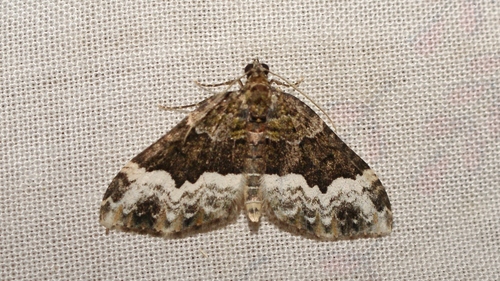
Cloaked Carpet
Euphyia biangulata
A master of mossy camouflage, the Cloaked Carpet is a stunning nocturnal visitor to European gardens. Its intricate green wings and dark central band make it a prized find for any backyard moth enthusiast.
Quick Identification
Size
Wingspan of 25–30 mm (approx. 1.0 to 1.2 inches)
Colors
Olive-green or brownish-green forewings with a broad, dark brown or blackish central band; pale gray hindwings
Key Features
- Broad, dark central 'cloak' band across the forewings
- Distinctive olive-green base color that may fade to yellow
- Sharp, jagged outer edge of the central dark band
- Small black discal spot often visible in the center of the band
When You’ll See Them
Geographic range
Where Does the Cloaked Carpet Live?
The Cloaked Carpet is primarily found across the Palearctic region, with its native heartland spanning most of Europe and extending into the Middle East. It is particularly well-established in the United Kingdom, France, and Germany, reaching as far north as southern Scandinavia. While it is a resident species within these territories, its presence is most concentrated in temperate lowland and upland forests where its larval food plants thrive.
Basemap © OpenStreetMap contributors
Behavior
The Cloaked Carpet is a nocturnal moth that relies heavily on its sophisticated camouflage to survive. During the daylight hours, it rests motionless on moss-covered tree trunks, lichen-encrusted rocks, or within dense foliage, where its green and brown patterns make it nearly invisible to birds and other predators. If it is disturbed during the day, it performs a quick, erratic fluttering flight to find a new hiding spot nearby.
As a member of the Geometridae family, its larvae are typical 'inchworms' that move by drawing their rear end up to their front legs, forming a loop. The adults are most active during the mid-summer months, emerging to find mates and lay eggs on specific host plants. They are harmless to humans and are frequently drawn to artificial light sources in suburban gardens and wooded areas.
EverydayEarth exclusive
Camera Tips
Capturing the Cloaked Carpet on an AI-powered camera requires a setup that takes advantage of their attraction to light. The most effective method is to position your camera facing a white sheet or a light-colored wall that is illuminated by a UV or 'black light' bulb. This creates a high-contrast background that allows the camera to easily identify the moth's silhouette and intricate wing patterns. Set your camera to a macro mode or ensure the lens is focused within 12 to 24 inches of the landing surface.
Placement is key; choose a sheltered spot near a garden hedge or at the edge of a wooded area where the wind won't disturb the moth's rest. A tripod height of 3 to 4 feet is usually ideal. Because moths move quickly and erratically, use a fast trigger speed. If your camera supports it, high-definition video bursts of 5-10 seconds are often better than still photos for capturing the moment the moth lands and settles its wings.
Since this species is most active in the summer, focus your efforts during warm, humid nights in July and August. Using a white LED flash will help preserve the characteristic olive-green color in your images, which is essential for distinguishing the Cloaked Carpet from its more brown-toned relatives. Avoid nights with heavy rain or high winds, as moth activity drops significantly in these conditions.
Similar Species
Species that look similar or are commonly confused with Cloaked Carpet.
Frequently Asked Questions
Record Cloaked Carpet at your habitat
Connect a camera to start building your own species record — AI identifies every visitor automatically.