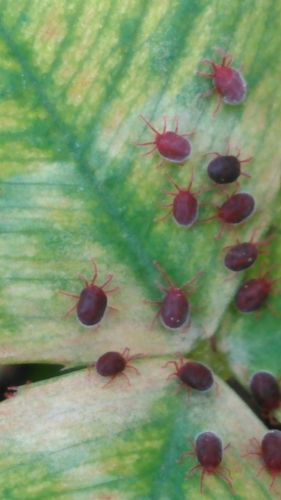
Clover Mite
Bryobia praetiosa
The Clover Mite is a tiny but vibrant red arachnid famous for its remarkably long front legs and its habit of swarming sunny windowsills in the spring. Though smaller than a pinhead, these harmless garden dwellers are a marvel of the microscopic world.
Quick Identification
Size
0.75 mm to 1 mm (0.03 inches); roughly the size of a pinhead.
Colors
Bright reddish-brown to deep brick red; younger nymphs may be a more vibrant orange-red.
Key Features
- Front legs are nearly double the length of the other six legs
- Bright reddish-brown, oval-shaped body
- Feathery scales on the body visible under magnification
- Eight legs total, typical of arachnids
When You’ll See Them
Geographic range
Where Does the Clover Mite Live?
The Clover Mite is a truly cosmopolitan species, found on every continent across the globe with the sole exception of Antarctica. They are exceptionally widespread throughout North America and Europe, where temperate climates and suburban landscaping provide the ideal balance of food and shelter. While they are native to the Northern Hemisphere, they have been successfully introduced to South America, Africa, and Australia, thriving wherever humans maintain grassy lawns and gardens.
Basemap © OpenStreetMap contributors
Behavior
Clover Mites are fascinating, albeit tiny, members of the spider mite family that are strictly herbivorous. Unlike many of their arachnid relatives, they do not spin webs or hunt other insects. Instead, they spend their days wandering across foliage and sun-drenched surfaces. They are most notable for their peculiar reproductive cycle; the species is entirely female, reproducing through parthenogenesis, which allows their populations to explode rapidly under the right environmental conditions.
These mites are harmless to humans and pets as they do not bite or transmit diseases, but they often become a nuisance when they migrate toward homes. During the spring and autumn, they are known to congregate in massive numbers on south-facing walls, windowsills, and foundations to soak up the sun's warmth. If they accidentally enter a home and are crushed, they leave behind a distinctive reddish stain—this is not blood, but rather the natural pigmentation of their bodies.
EverydayEarth exclusive
Camera Tips
Capturing the Clover Mite on a backyard camera is a challenge that requires specialized macro equipment. Because these mites are less than a millimeter long, a standard trail camera will likely only see them as tiny, moving red dots. For the best results, use a camera with a dedicated macro lens or a high-quality smartphone with a macro attachment focused on a flat, light-colored surface like a windowsill or a white-painted garden stake.
Location is the most critical factor for success. Seek out south-facing walls or concrete foundations that receive direct sunlight during the morning and early afternoon. Clover Mites are heat-seekers, and they will congregate in these areas by the thousands during the early spring. Placing a white card or a piece of light-colored stone in a sunny spot near a lush lawn can act as a natural stage for your camera, providing the contrast needed for the AI to detect their movement.
Since these mites are most active when temperatures are between 50°F and 75°F (10°C to 24°C), timing your sessions for bright, mild spring days is essential. Avoid high-wind days, as these tiny creatures are easily blown away. Set your camera to a high frame rate or use high-resolution time-lapse photography to capture their frantic, wandering movement patterns across the surface. Ensure your focus is locked and your depth of field is as wide as possible to keep the moving mites in focus.
Frequently Asked Questions
Record Clover Mite at your habitat
Connect a camera to start building your own species record — AI identifies every visitor automatically.