Club Silverline
Cigaritis syama
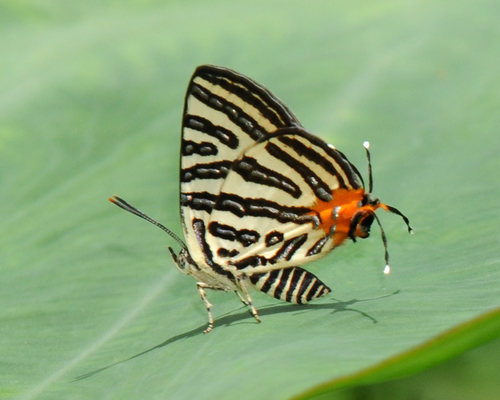
A shimmering marvel of the Lycaenidae family, the Club Silverline dazzles with its metallic wing patterns and a fascinating 'false head' designed to trick predators. Common in gardens but rarely still, it is a master of the sun-dappled edge.
Quick Identification
Size
Wingspan of 27–33 mm (1.1–1.3 inches); a small and delicate lycaenid butterfly.
Colors
Underside is pale yellow or cream with striking black-bordered silver bands; upperside is dull brown, with males showing a violet-blue iridescence.
Key Features
- Intricate silver bands with black outlines on the wing underside
- Two delicate, hair-like 'tails' on each hindwing
- Distinctive club-shaped silver mark at the base of the hindwing
- Large, dark eyes and orange-tinted legs
When You’ll See Them
Geographic range
Where Does the Club Silverline Live?
The Club Silverline is a native treasure of Southeast Asia, thriving across a wide longitudinal band from Northeast India to the Philippines. Its core range includes the tropical landscapes of Thailand, Malaysia, Singapore, and Indonesia, while also extending northward into southern China and Taiwan. Because it adapts exceptionally well to human presence, it is one of the more common 'silverline' species found in urban parks and residential backyards throughout the Indo-Malayan region.
Basemap © OpenStreetMap contributors
Behavior
The Club Silverline is an energetic and fast-flying butterfly frequently seen in sun-dappled forest edges and urban gardens. It is known for its erratic, 'skipping' flight pattern, making it a challenge to track with the eye until it settles on a leaf. When at rest, it usually keeps its wings tightly closed, showcasing its brilliant silver-and-yellow underside, which acts as a form of disruptive camouflage against the play of light and shadow.
This species is famous for its complex symbiotic relationship with Crematogaster ants. The caterpillars possess specialized glands that produce a sugary liquid the ants find irresistible. In return for this meal, the ants act as a private security detail, protecting the larvae from parasitic wasps and spiders. Interestingly, the butterfly's 'tails' on its hindwings, combined with eye-like spots, create a 'false head' that misleads predators into attacking the wrong end of the insect.
EverydayEarth exclusive
Camera Tips
To successfully capture the Club Silverline on a backyard camera, you need to think small and fast. These butterflies are diminutive, so standard trail cameras might struggle with focus unless they have a macro lens or a close-up attachment. Set your camera focus between 12 and 18 inches and aim it at a sun-exposed 'perching leaf' or a cluster of nectar-rich flowers. They are habitual creatures and will often return to the exact same leaf after a short patrol flight, giving you multiple chances for the perfect shot.
Lighting is critical for bringing out the metallic luster of the silver bands. Position your camera so it is slightly angled toward the morning sun; this side-lighting will make the silver markings 'pop' against the yellow background. Avoid placing the camera where it will be heavily backlit, as the butterfly will simply appear as a dark silhouette. Because they move their wings in a characteristic twitching motion to animate their 'false tails,' using a high-frame-rate video setting (at least 60fps) is better than still photos for capturing their unique personality.
Since these butterflies are attracted to moisture and minerals as well as nectar, you can encourage them to land in front of your lens by creating a 'puddling' station. A shallow dish with damp sand and a pinch of sea salt can be an irresistible draw. If you are using an AI-powered camera on the EverydayEarth platform, ensure your motion sensitivity is set to 'High' to detect the rapid movement of such a small subject, and schedule your recordings for the hottest part of the day when they are most active.
Similar Species
Species that look similar or are commonly confused with Club Silverline.
Frequently Asked Questions
Record Club Silverline at your habitat
Connect a camera to start building your own species record — AI identifies every visitor automatically.