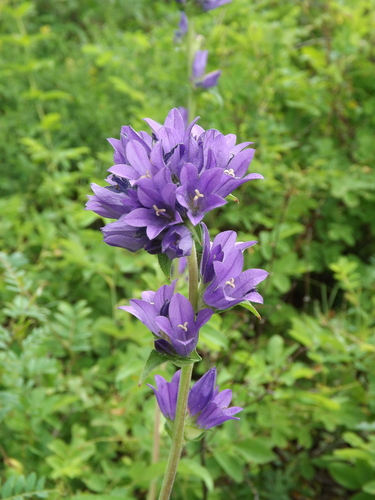
clustered bellflower
Campanula glomerata
A vibrant burst of violet-purple, the clustered bellflower is a top-tier pollinator magnet that transforms summer gardens into buzzing wildlife hubs.
Quick Identification
Size
Stands 20-60 cm (8-24 inches) tall with individual flower bells measuring 2-3 cm (1 inch) in length
Colors
Deep violet-purple to rich blue petals, often with reddish-tinted green stems and dark green hairy leaves
Key Features
- Dense, rounded cluster of upward-facing bell-shaped flowers at the top of the stem
- Unbranched, sturdy stems covered in fine white hairs
- Basal leaves are heart-shaped while upper leaves are narrow and clasp the stem
- Flowers possess five pointed lobes and a prominent central style
When You’ll See Them
Geographic range
Where Does the clustered bellflower Live?
The clustered bellflower is native to the temperate reaches of Eurasia, spanning from the British Isles and Western Europe through Central Asia and into the islands of Japan. In its native range, it is a celebrated sight in traditional hay meadows and limestone downs. It has been widely introduced to North America as a garden ornamental and has since naturalized across much of the northern United States and southern Canada, where it thrives in cool-temperate climates.
Basemap © OpenStreetMap contributors
Behavior
The clustered bellflower is a hardy, clump-forming perennial known for its 'determinate' growth habit, meaning the main stem ends in a vibrant floral cluster. Unlike many other bellflowers that feature nodding or drooping bells along the length of the stalk, this species holds its blossoms upright in a crowded head, maximizing its visibility to pollinators from above. It spreads through a creeping rhizome system, eventually forming lush mats of green foliage that provide excellent ground cover before the flowering spikes emerge in early summer.
As a key player in the backyard ecosystem, it acts as a high-traffic nectar station. It is specifically adapted to attract long-tongued bees, such as bumblebees and honeybees, which can reach deep into the tubular bells. In garden settings, it is a social plant, often seen intermingling with grasses or other wildflowers, and it is highly resilient to human activity, often thriving in the 'disturbed' soils of suburban garden borders or path edges.
EverydayEarth exclusive
Camera Tips
To capture the clustered bellflower effectively, you should treat the plant as a stage for insect activity. Place your AI-powered camera on a low tripod or ground stake, positioning the lens roughly 12 to 18 inches away from the primary flower cluster. Angle the camera slightly upward to capture the interior of the bell-shaped blooms where pollinators congregate. Because this species has a rigid stem, it remains relatively stable in the wind, making it an ideal subject for high-resolution macro shots without the blur typical of more delicate wildflowers.
Since the clustered bellflower is a magnet for bees and butterflies, set your camera to a high-frequency trigger mode during the peak heat of the day. Between 11 AM and 3 PM, nectar production is often at its highest, leading to more frequent visits from pollinators. If your camera supports it, use a 'Fast Shutter' setting to freeze the rapid wing movements of bumblebees. No bait is required, as the flower's deep purple hue and concentrated nectar are natural lures that bring the wildlife directly to your lens.
Consider using a time-lapse setting to document the 'unfolding' of the cluster. Over a period of 48 to 72 hours, you can record the transition from tight green buds to a full explosion of violet. For the best lighting, ensure the camera is positioned with the sun behind it (facing north or south) to avoid harsh silhouetting, which can wash out the deep purple pigments of the petals. In the late evening, you might even catch 'sleeping' bees tucked inside the bells for the night, providing a unique look at insect behavior.
Similar Species
Species that look similar or are commonly confused with clustered bellflower.
Frequently Asked Questions
Record clustered bellflower at your habitat
Connect a camera to start building your own species record — AI identifies every visitor automatically.