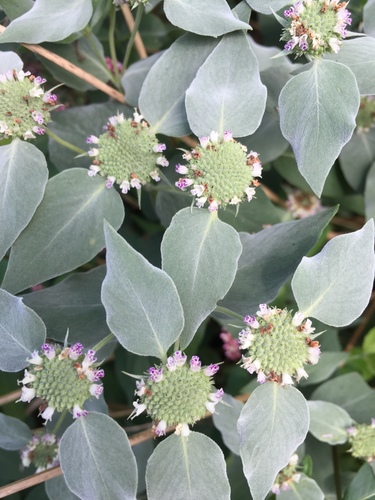
Clustered Mountainmint
Pycnanthemum muticum
A silver-crowned powerhouse of the meadow, Clustered Mountainmint is the ultimate magnet for butterflies and beneficial wasps. Its 'frosted' leaves and minty fragrance make it as beautiful to humans as it is vital to local ecosystems.
Quick Identification
Size
60-90 cm (2-3 ft) tall and wide
Colors
Dark green lance-shaped leaves topped with prominent silvery-white bracts; clusters of tiny white or pale pink flowers often featuring purple spotting.
Key Features
- Distinctive silvery-white 'frosted' bracts at the top of stems
- Square stems with a sturdy, upright growth habit
- Dense, flat-topped flower clusters (cymes)
- Strong, pleasant spearmint aroma when foliage is touched
When You’ll See Them
Geographic range
Where Does the Clustered Mountainmint Live?
Native to the North American continent, Clustered Mountainmint is primarily found across the Eastern United States. Its range extends from the northern reaches of Maine and Vermont, stretching southward down the Atlantic coast to Florida, and reaching as far west as eastern Texas and Michigan. This hardy perennial is a staple of the Appalachian region and thrives in the diverse climates of the Mid-Atlantic and Southeast, where it populates sunny meadows and the dappled edges of deciduous forests.
Basemap © OpenStreetMap contributors
Behavior
In the wild, it acts as a pioneer species in meadow transitions and forest edges, providing dense cover for small ground-dwelling fauna. For the backyard observer, its behavior is most notable for the constant 'hum' of activity it generates; it is rarely seen without a visitor. The plant is also highly resilient, demonstrating excellent drought tolerance once established and remaining largely ignored by deer and rabbits due to the high concentration of pulegone and other aromatic oils in its leaves.
EverydayEarth exclusive
Camera Tips
To capture the incredible diversity of life attracted to Clustered Mountainmint, position your camera on a tripod at a height of about 2 to 3 feet, directly level with the flower heads. A 45-degree angle looking slightly down onto the silvery bracts works best, as it allows the AI to capture the wing patterns of visiting butterflies and the distinct markings of predatory wasps. Because this plant is a 'pollinator hub,' you can expect high-frequency triggers; ensure your camera is set to a short reset interval or high-speed burst mode to catch fast-moving insects.
Lighting is crucial for this species due to its unique silvery foliage. The bracts can highly reflect midday sun, potentially washing out your images. For the best results, set your camera to focus on the plant in the early morning or late afternoon when the 'golden hour' light emphasizes the texture of the leaves and the delicate pink spots on the flowers. If your camera allows for exposure adjustment, slightly underexposing can help preserve the detail in those bright, snowy-looking bracts.
Since this plant is stationary, it is the perfect candidate for time-lapse photography. Set your AI camera to take a frame every 5-10 minutes during the peak blooming months of July and August. This will not only show the progression of the bloom but also create a fascinating record of the 'changing of the guard' as different species of bees, wasps, and butterflies visit at different times of the day. No bait is needed—the nectar is the natural lure for the wildlife you want to photograph!
Similar Species
Species that look similar or are commonly confused with Clustered Mountainmint.
Frequently Asked Questions
Record Clustered Mountainmint at your habitat
Connect a camera to start building your own species record — AI identifies every visitor automatically.