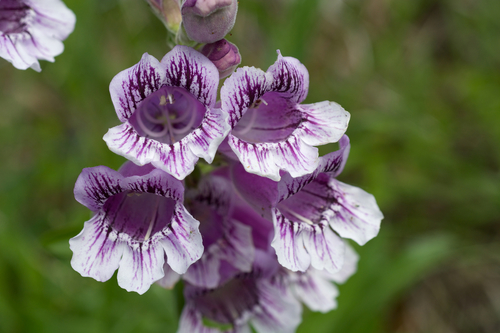
cobaea beardtongue
Penstemon cobaea
Featuring the largest flowers of any beardtongue species, Penstemon cobaea transforms the rugged Great Plains into a sea of purple and white bells every spring. It is a favorite for bumblebees and a must-have for any prairie-style backyard garden.
Quick Identification
Size
Stems 30–60 cm (12–24 inches) tall; flowers 5 cm (2 inches) long
Colors
Creamy white to pale lavender or deep pink with prominent magenta or purple nectar-guide lines inside the throat
Key Features
- Large bell-shaped flowers up to 2 inches long
- Sticky, glandular hairs covering stems and flower clusters
- Dark purple stripes inside the flower throat
- Opposite, sharply-toothed leaves that partially clasp the stem
When You’ll See Them
Geographic range
Where Does the cobaea beardtongue Live?
Native to the heart of North America, the Cobaea beardtongue is a quintessential spirit of the Great Plains. Its core range stretches from the southern borders of Nebraska through Kansas and Oklahoma, reaching deep into the limestone-rich soils of central Texas. You can also find vibrant populations thriving in the Ozark Mountains of Missouri and Arkansas, while scattered populations in Illinois and Ohio are generally considered naturalized introductions.
Basemap © OpenStreetMap contributors
Behavior
Cobaea beardtongue is a hardy perennial that plays a vital role in its prairie ecosystem. Unlike many smaller-flowered Penstemons, this species has evolved large, robust blooms specifically to accommodate heavy-bodied pollinators like bumblebees. When a bee enters the wide mouth of the flower, the plant's unique 'beardtongue'—a sterile, fuzzy stamen—brushes against the insect's back, ensuring the efficient transfer of pollen as the visitor crawls deep inside to reach the nectar.
This plant is a 'pioneer' species in many ways, often being one of the most showy displays in rocky or disturbed limestone soils during late spring. While it doesn't move in the traditional sense, its growth cycle is a fascinating study in adaptation; it remains as a low-growing basal rosette of leaves during the winter months to protect itself from the wind, only sending up its dramatic flowering spikes once the threat of frost has passed in May or June.
EverydayEarth exclusive
Camera Tips
To capture the stunning beauty of Cobaea beardtongue, position your camera on a low tripod about 2 to 3 feet from the flower spike. Because these flowers are large, they make excellent subjects for macro photography. If your camera has a 'Time-Lapse' mode, set it to trigger every 10-15 minutes over a 48-hour period in late May; this allows you to record the spectacular 'unfolding' of the buds into full bell-shaped blooms.
Since this species is a magnet for pollinators, use a high-speed trigger setting to catch bumblebees and hummingbirds in action. Position the camera so the sun is behind it (or at a 45-degree angle) to illuminate the interior of the flower, which reveals the intricate magenta nectar guides. If your AI camera supports 'Motion Zones,' highlight the mouth of the largest flower to avoid false triggers from wind-blown leaves.
Wind is the biggest challenge when filming prairie plants. To get crisp shots, use a small garden stake to subtly secure the stem out of the camera's view, or wait for the 'golden hour' at dawn when the prairie winds are usually at their calmest. The soft morning light also helps prevent the pale petals from appearing 'washed out' in your footage.
For the best results in a backyard setting, plant your beardtongue in a cluster. A camera aimed at a group of 3-5 plants will see much more insect activity than one aimed at a single stem. Ensure the area around the base of the plant is clear of tall grass so the camera’s infrared sensors aren't blocked during evening transitions.
Similar Species
Species that look similar or are commonly confused with cobaea beardtongue.
Frequently Asked Questions
Record cobaea beardtongue at your habitat
Connect a camera to start building your own species record — AI identifies every visitor automatically.