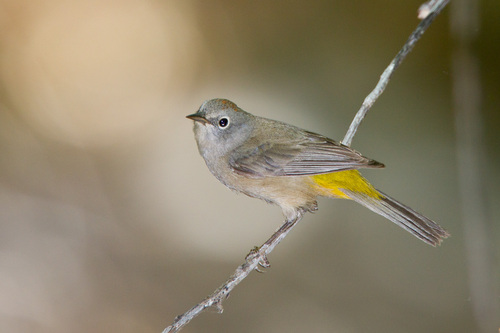
Colima Warbler
Leiothlypis crissalis
A hidden treasure of the Chisos Mountains and the Sierra Madres, the Colima Warbler is a subtle beauty of the high-altitude woods. This rare songbird offers a rewarding challenge for any wildlife enthusiast brave enough to climb into its rugged home.
Quick Identification
Size
4.7–5.9 inches (12–15 cm) long; 8.5–9.5 inches (21–24 cm) wingspan; 0.35–0.45 oz (10–13 g)
Colors
Uniform brownish-gray body, paler gray breast, bright yellow-to-cinnamon undertail coverts, and a faint white eye-ring. Males and females look similar, though males may have a more prominent orange crown patch.
Key Features
- Distinctive yellow or cinnamon-colored undertail coverts
- Faint, broken white eye-ring
- Heavy-bodied for a warbler with a relatively thick bill
- Orange crown patch usually hidden except during displays
When You’ll See Them
Geographic range
Where Does the Colima Warbler Live?
The Colima Warbler is a specialist of the montane regions of North America, with a very restricted range centered in the mountains of central and northern Mexico. It is most commonly found in the Sierra Madre Oriental and Occidental, though its northern limit reaches the United States only within the Chisos Mountains of Big Bend National Park in Texas. This bird is a short-distance migrant, spending its winters on the Pacific slope of southwestern Mexico in similar high-elevation forests.
Basemap © OpenStreetMap contributors
Behavior
The Colima Warbler is a somewhat shy and deliberate bird, moving more slowly than the frantic pace associated with most New World warblers. It is largely a ground-foraging species, often seen hopping through thick layers of oak leaf litter or poking through low-growing shrubs in search of prey. Because it inhabits rugged, high-altitude terrain, it is rarely encountered by the casual observer and maintains a secretive profile during the nesting season.
During the breeding season, males are most noticeable when they sing from the mid-story of oak or pine trees, though they quickly retreat to the undergrowth when disturbed. They are generally solitary or found in pairs, showing high site fidelity to their specific mountain canyons. While they aren't typically aggressive toward humans, their remote habitat means they have little interaction with urban environments.
EverydayEarth exclusive
Camera Tips
To capture high-quality images or video of the Colima Warbler, you must account for their ground-dwelling tendencies. Place your camera at a low height, approximately 18 to 24 inches off the ground, and aim it toward clearings in the leaf litter near the base of oak trees. This species spends significant time tossing leaves aside to find insects, so a ground-level perspective is essential for capturing natural foraging behavior.
Water is a powerful lure for this warbler, especially in the relatively dry environments of the Chisos Mountains. If you have access to a small mountain spring, a dripping seep, or a low-profile birdbath in a woodland setting, point your camera there. Ensure the camera is positioned to capture the bird as it approaches the water's edge, as they prefer to drink and bathe in shallow, shaded spots with nearby cover for a quick escape.
Because these birds live in the dappled light of dense forests, use a camera with a high-quality sensor that handles shadows well. Set your trigger speed to the fastest possible setting to catch their quick hops and tail-flicks. If your camera supports it, high-definition video is often better than still photos for this species, as their subtle gray coloration can blend into the background, but their unique movement and song are unmistakable. Early morning is the prime time for recording, as the light is soft and the birds are most active.
Similar Species
Species that look similar or are commonly confused with Colima Warbler.
Virginia's Warbler
Smaller with a distinct yellow patch on the breast and a much whiter belly.
Orange-crowned Warbler
Generally more yellow-green overall with blurry streaking on the breast, unlike the clean gray of the Colima.
Lucy's Warbler
Much smaller and paler gray, with a distinctive rufous (reddish) rump and crown patch.
Frequently Asked Questions
Record Colima Warbler at your habitat
Connect a camera to start building your own species record — AI identifies every visitor automatically.