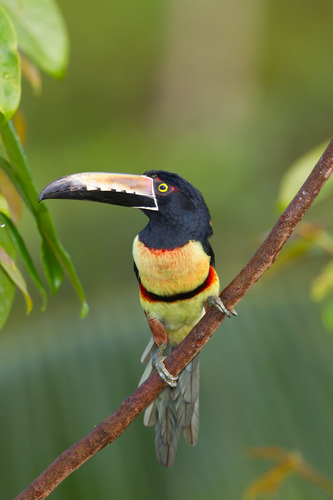
Collared Aracari
Pteroglossus torquatus
With its striking serrated bill and vibrant yellow chest, the Collared Aracari is a masterpiece of tropical color. This highly social member of the toucan family brings energy and charisma to the forest canopy in small, lively flocks.
Quick Identification
Size
39–41 cm (15–16 in) in length; 190–275 g (6.7–9.7 oz) in weight
Colors
Black head and neck; dark olive-green back; yellow breast with a central black spot and a red-and-black abdominal band; ivory-colored upper bill with black markings.
Key Features
- Serrated 'saw-toothed' ivory and black bill
- Broad red-and-black band across a bright yellow belly
- Bright yellow eyes with bare red skin around the orbital area
- Highly social, often seen in groups of 6-15
When You’ll See Them
Sightings on EverydayEarth
Apr 7, 2026
A vibrant gathering occurs at the fruit feeder as a pair of Keel-billed Toucans arrive to forage. A male Crimson-backed Tanager is briefly seen moving through the vegetation near the food, while a Collared Aracari perches steadily on a branch to the right, observing the activity.
Apr 4, 2026
A group of Gray-headed Chachalacas are active around the feeding station, with several perched on the mossy branches and one feeding on orange slices on the platform. A Collared Aracari flies in and lands on the left side of the feeder, where it begins to consume a piece of watermelon.
Apr 3, 2026
A Collared Aracari is seen foraging at the fruit feeder. It hops from the moss-covered branches onto the tray, using its large bill to investigate the available oranges and bananas before moving to the lower-right section of the feeder.
Geographic range
Where Does the Collared Aracari Live?
Native to the Neotropical regions of the Americas, the Collared Aracari is a common sight in the lush lowlands from southern Mexico through Central America. Its core range encompasses the Caribbean and Pacific slopes of countries like Belize, Guatemala, Costa Rica, and Panama. In South America, it is frequently found in the northern reaches of Colombia and Venezuela, preferring humid, wooded environments over high-altitude terrains.
Basemap © OpenStreetMap contributors
Recorded on EverydayEarth
Behavior
Collared Aracaris are intensely social birds, rarely seen alone. They move through the forest in small, noisy flocks that function as close-knit family units. They are famous for their communal sleeping habits; unlike most birds that sleep on branches, the entire group will often cram into a single abandoned woodpecker hole at night, with their tails folded over their backs to save space. This social bond extends to their breeding, where 'helpers' (often older siblings) assist the parents in feeding the chicks.
In the canopy, they are acrobatic and energetic foragers. They use their massive but surprisingly lightweight bills to reach fruit on thin branches that wouldn't support their weight. Their flight is a distinctive pattern of several rapid flaps followed by a glide, often moving from tree to tree in a 'follow-the-leader' fashion. While they can be vocal and chattery, they often become quiet and cautious when they sense a predator like a hawk or a large snake.
EverydayEarth exclusive
Camera Tips
To capture the Collared Aracari on camera, you must think vertically. These birds spend the vast majority of their time in the canopy, so a ground-level camera will almost never see them. If you have tall trees on your property—especially those with ripening fruit like papaya, banana, or palm nuts—mount your camera at least 10 to 15 feet high on a neighboring branch. Angle the lens downward toward the fruit clusters or a sturdy horizontal limb that serves as a natural landing perch.
Baiting is incredibly effective for this species. An elevated platform feeder stocked with sliced tropical fruits (papaya is their favorite) will act as a major draw. Because they travel in social groups, try to set a wide field of view so you don't miss the interactions between multiple birds. If you live in a region with a pronounced dry season, an elevated birdbath or a dripping water feature can be an irresistible lure during the heat of the afternoon.
Settings are crucial because these birds are fast and the tropical forest can be quite dark. Use a fast shutter speed to avoid motion blur and set your camera to record 15–30 second high-definition video clips. Watching their social behavior—such as passing fruit to one another or 'fencing' with their bills—is far more rewarding than a still photo. Ensure your camera is active during the 'golden hours' just after sunrise, as they are most active and vocal before the midday heat sets in.
Finally, pay attention to the lighting. Aracaris have high-contrast plumage with dark blacks and bright yellows. To avoid 'blown-out' highlights on their yellow chests, try to position the camera so the morning sun is behind the lens, providing even, front-lit illumination. Using a high-speed memory card is recommended to keep up with the rapid-fire triggers when a whole flock arrives at once.
Similar Species
Species that look similar or are commonly confused with Collared Aracari.
Fiery-billed Aracari
The Fiery-billed has a bright orange-red upper mandible and the red band on its belly is much broader and more solid.
Pale-mandibled Aracari
Primarily found in Western Ecuador; it lacks the dark spot in the center of the yellow breast seen on the Collared Aracari.
Black-necked Aracari
Found further south in the Amazon; it has a solid black throat and chest without the distinct 'collared' pattern.
Frequently Asked Questions
Record Collared Aracari at your habitat
Connect a camera to start building your own species record — AI identifies every visitor automatically.