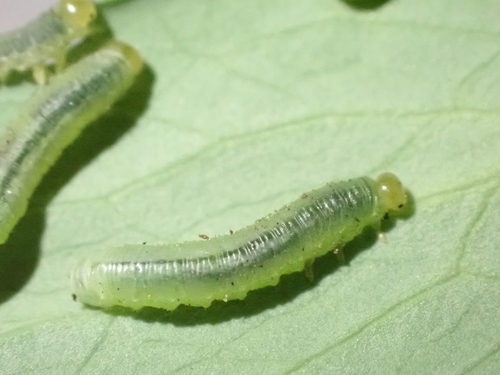
columbine sawfly
Pristiphora rufipes
The columbine sawfly is the ultimate garden specialist, a tiny architect of destruction that can turn a lush columbine into a skeletal masterpiece in days.
Quick Identification
Size
Adults 5-7 mm (0.2-0.28 in); Larvae up to 15 mm (0.6 in) long
Colors
Adults are mostly black with pale yellow to reddish-orange legs; larvae are a solid bright green with a pale yellow or light brown head.
Key Features
- Small black winged adult with distinctive orange-yellow legs
- Larvae have 6+ pairs of prolegs (unlike caterpillars)
- Found exclusively on columbine (Aquilegia) plants
- Leaves a 'skeletonized' pattern on foliage
When You’ll See Them
Geographic range
Where Does the columbine sawfly Live?
The columbine sawfly is originally native to Europe, where it is found across most of the continent from the United Kingdom to Scandinavia and southward. In recent decades, it has become a widely established introduced species in North America. It is now a common sight in temperate regions of the United States and Canada, effectively following the distribution of columbine as a popular garden ornamental.
Basemap © OpenStreetMap contributors
Behavior
The columbine sawfly is a specialized garden insect whose life revolves entirely around its namesake host plant. Despite being called a 'fly,' the adult is actually a stingless wasp. They are largely solitary and spend their short lives searching for healthy columbines to lay eggs upon. Humans rarely notice the adults, as they are small and fly quickly between plants, but the larval stage is nearly impossible to miss due to their voracious appetite.
When the eggs hatch, the larvae begin feeding in groups, starting at the edges of the leaves and moving toward the center. They are masters of camouflage, pressing their bright green bodies against the leaf margins to blend in with the foliage. When disturbed, they may exhibit a characteristic 'S' shape or drop from the leaf to the ground to avoid predators. After they have finished feeding, they migrate into the soil to spin cocoons and pupate, often producing multiple generations in a single summer.
EverydayEarth exclusive
Camera Tips
To capture the columbine sawfly on your backyard camera, you must focus entirely on the host plant. Position your camera on a tripod or mount it very close to a healthy patch of columbine (Aquilegia). Because these insects are tiny, a macro lens or a camera with a short minimum focus distance is essential. Aim the lens at the undersides of the leaves or the leaf edges, as this is where larvae are most likely to be found during their early stages of growth.
Lighting is your biggest challenge and your best friend. These sawflies are most active in bright, warm conditions. If your camera is shaded by the columbine's foliage, use a small LED light or a reflector to bounce sunlight into the darker areas of the plant. This will help the AI or motion sensor detect the subtle movements of the green larvae against the green leaves. Set your camera to a high frame rate or 'burst mode' to catch the adults in flight, as they move rapidly and rarely stay still for long.
If you notice the leaves of your columbine look like lace or are missing chunks, the sawflies are already there. This is the perfect time to set up a time-lapse. A 24-hour time-lapse with a photo taken every 5 to 10 minutes can create a stunning visual of the larvae's 'strip-mining' behavior, showing the plant foliage disappearing in real-time. Make sure to check the soil at the base of the plant as well; you might catch the larvae as they descend to pupate in the late afternoon.
Similar Species
Species that look similar or are commonly confused with columbine sawfly.
Frequently Asked Questions
Record columbine sawfly at your habitat
Connect a camera to start building your own species record — AI identifies every visitor automatically.