Common Barking Gecko
Reptiles Active at night

Common Barking Gecko

Ptenopus garrulus

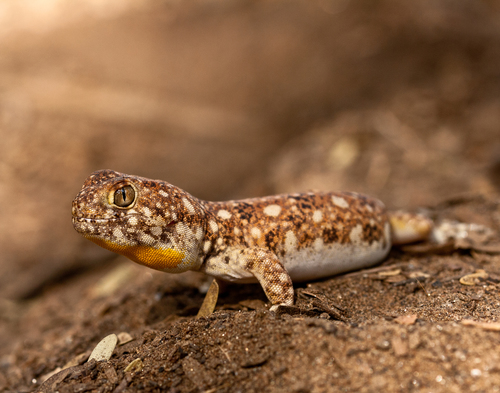
Known as the chorus of the Kalahari, the Common Barking Gecko is more often heard than seen. These pint-sized reptiles transform arid landscapes into a symphony of rhythmic clicks every sunset.

0 Sightings
0 Habitats

Quick Identification

straighten

Size

8-11 cm (3.1-4.3 inches) in total length; weight approximately 5-10 grams

palette

Colors

Sandy orange, cream, or pale brown with darker mottled blotches; males possess a distinct bright yellow throat used during signaling.

visibility

Key Features

  • Large, blunt head with oversized lidless eyes
  • Fringed toes specialized for swimming through loose sand
  • Stocky, cylindrical body with a short, tapering tail
  • Males feature a vibrant yellow throat patch
add_a_photo
Is this a Common Barking Gecko?

Drop a photo or video, or paste from clipboard

When You’ll See Them

schedule
Activity pattern Active at night
brightness_5
Peak hours 6 PM - 10 PM
calendar_month
Season September-March
restaurant
Diet Strictly insectivorous, they wait near their burrow entrances to ambush passing termites, ants, and small beetles.
park
Habitat Arid sandy plains, dunes, and dry riverbeds with loose, fine-grained soil.

public Geographic range

Where Does the Common Barking Gecko Live?

Native to the arid southern tip of the African continent, the Common Barking Gecko is a specialist of the sandy biomes. Its core range spans the vast Kalahari and Namib deserts, stretching across Namibia, Botswana, and the northern provinces of South Africa. You can also find them in the dry western reaches of Zimbabwe, where the soil remains loose enough for their burrowing lifestyle.

Basemap © OpenStreetMap contributors

4 Countries
1.5M km² Range
Least Concern Conservation
NA Namibia BW Botswana ZA South Africa ZW Zimbabwe
eco
iNaturalist / Verified observation data
View on iNaturalist open_in_new

Explore more Reptiles arrow_forward

Behavior

The Common Barking Gecko is the quintessential desert ventriloquist, spending the heat of the day in a self-excavated burrow that can reach depths of up to a meter. As the sun begins to set, the males emerge partially from their tunnels to begin a rhythmic calling ritual. This 'barking'—a series of sharp clicks—is designed to attract mates and defend territory, creating a wall of sound across the dunes during the twilight hours.

These geckos are highly territorial and exceptionally shy. They rely on their incredible camouflage to blend into the sand, but their primary defense is a lightning-fast retreat into their burrows at the slightest vibration. Despite their vocal nature, they are solitary hunters that only interact during the breeding season when the evening 'chorus' is at its peak.

photo_camera EverydayEarth exclusive

Camera Tips

To capture these elusive vocalists, placement is everything. Look for small, crescent-shaped mounds of sand next to a hole—this is the 'front porch' of a Common Barking Gecko's burrow. Position your camera on a mini-tripod or ground stake just a few inches off the sand, angled slightly downward toward the entrance. Because these geckos are extremely sensitive to ground vibrations, avoid checking the camera frequently or walking near the burrow site during active hours.

Lighting is your biggest challenge. Because they are most active during the 'blue hour' of twilight and through the night, ensure your camera has a high-quality infrared flash that won't overexpose subjects at close range. If your device has a 'shutter lag' or PIR sensitivity setting, set it to the highest sensitivity to catch the gecko the moment it pokes its head out to bark. A wide-angle lens is preferable to capture the context of the burrow mound.

While they don't respond to traditional baits like fruit or meat, you can sometimes encourage activity by placing a very dim, warm-toned light a few meters away to attract the small moths and termites they prey on. However, the best 'lure' is simply a quiet, undisturbed environment. Peak activity occurs on warm, windless evenings following a rain, as this is when their insect prey is most abundant and the sand is stable for burrowing. Ensure your camera is protected from blowing sand, which can scratch the lens or trigger false motions.

Similar Species

Species that look similar or are commonly confused with Common Barking Gecko.

Browse all Reptiles arrow_forward

Frequently Asked Questions

Common Barking Geckos are strictly nocturnal but are most famous for their activity at dusk. Males begin calling about 15-20 minutes after sunset and may continue for several hours into the night, especially on warm evenings.
If you live in their native range, the best way to attract them is to maintain patches of undisturbed, deep sandy soil and avoid using pesticides. They require natural insect populations, like termites and ants, to survive.
They are insectivores that specialize in small ground-dwelling invertebrates. Their diet consists largely of harvester termites, ants, and small beetles that wander near their burrow entrances.
They are common in suburban gardens in arid regions like Upington or Windhoek, provided the gardens have sandy soil rather than thick lawns. They are often detected by their loud calls rather than visual sightings.
The Common Barking Gecko (P. garrulus) is distinguished by its specific call—a single 'click' repeated. Similar species like the Giant Barking Gecko are larger and have multi-syllable calls, while Carp's Barking Gecko is found only in specific gravel plains of the Namib.

Record Common Barking Gecko at your habitat

Connect a camera to start building your own species record — AI identifies every visitor automatically.

Join free Identify a photo