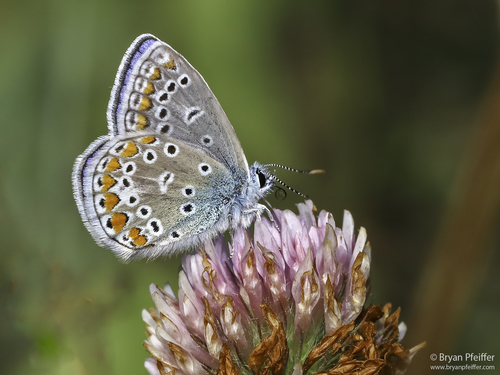
Common Blue
Polyommatus icarus
The Common Blue is a tiny jewel of the grasslands, bringing a splash of azure to meadows across the globe. As the most widespread of all 'blue' butterflies, it is a frequent and welcome visitor to any wildlife-friendly backyard.
Quick Identification
Size
Wingspan typically ranges from 29 to 38 mm (1.1 to 1.5 inches)
Colors
Males are bright lilac-blue with thin black borders; females are primarily brown with orange spots and blue dusting near the body; both have spotted grey-beige undersides
Key Features
- Males have vibrant blue upper wings with a fine white fringe
- Females are brown with a row of orange spots along the wing edges
- Underside features black spots with white rings and a row of orange crescents
- Small, erratic flight pattern close to the ground
When You’ll See Them
Geographic range
Where Does the Common Blue Live?
This widespread butterfly is native to the Palearctic realm, stretching across the entirety of Europe, North Africa, and temperate Asia to the Russian Far East. It is one of the most ubiquitous butterflies in the United Kingdom and continental Europe, inhabiting almost every environment from sea level to high mountain pastures. In recent decades, the species has successfully established itself in North America after being accidentally introduced to eastern Canada, where it is now steadily expanding into the northeastern United States.
Basemap © OpenStreetMap contributors
Behavior
The Common Blue is a sun-loving butterfly known for its energetic and low-flying fluttering across meadows. Males are particularly territorial and spend much of their day 'patrolling' a chosen patch of habitat or basking on tall grass stems, waiting for females to fly by. They are frequent nectar-feeders, moving rapidly between low-growing wildflowers to maintain the energy needed for their active flight.
As the sun begins to set or when weather turns cloudy, these butterflies exhibit a charming communal roosting behavior. They gather on the heads of grasses or dried flower spikes, often resting head-downwards. During these cooler periods, they become quite lethargic, allowing for much closer observation than during the peak heat of the day. They are also known for a symbiotic relationship with ants; the larvae produce a sugary secretion that ants harvest, and in return, the ants protect the caterpillars from predators.
EverydayEarth exclusive
Camera Tips
To capture high-quality images of the Common Blue using a backyard camera, you must focus on 'staging' the environment. These butterflies are small and move quickly, so a macro lens or a camera with a very short minimum focal distance is essential. Position your camera on a tripod roughly 12 to 20 inches away from a cluster of their favorite nectar plants, such as Bird’s-foot Trefoil or lavender. Aim for a side-on angle to catch the intricate spot patterns on the wing undersides, or a top-down view to record the male's brilliant blue upper wings.
Timing is the most critical factor for success. While they are most active mid-day, they are also most difficult to photograph then because they rarely stay still. For the best results, set your camera to trigger during the 'golden hours' of early morning or late evening. This is when the butterflies are roosting on grass stems; they are nearly immobile as they wait for the sun to warm their wings, providing the perfect opportunity for sharp, detailed shots without motion blur.
If you are using an AI-powered trail camera, place it low to the ground—no higher than 2 feet—since Common Blues spend most of their time in the lower herb layer. Ensure your background is far enough away to create a soft, blurred effect, which helps the butterfly’s colors stand out. Avoid using a direct flash, which can reflect harshly off their iridescent scales; instead, use a white reflector or rely on diffused natural light for the most natural-looking results.
Similar Species
Species that look similar or are commonly confused with Common Blue.
Frequently Asked Questions
Record Common Blue at your habitat
Connect a camera to start building your own species record — AI identifies every visitor automatically.