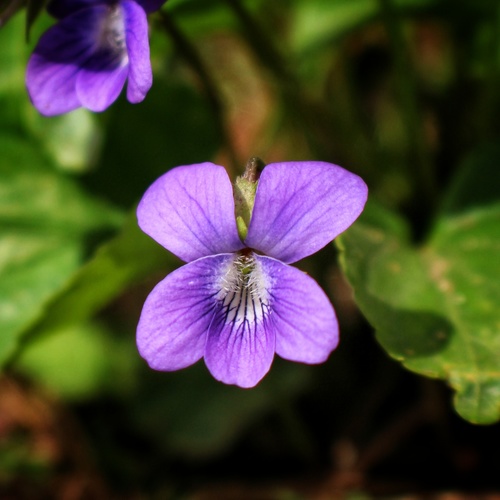
common blue violet
Viola sororia
The common blue violet is a charming herald of spring, transforming suburban lawns into purple-dappled meadows while providing a vital lifeline for local butterflies.
Quick Identification
Size
Height: 10-20 cm (4-8 inches); Flower width: 2-3 cm (0.75-1.25 inches)
Colors
Deep purple to sky blue petals with white throats and fine dark purple veins; bright green heart-shaped foliage
Key Features
- Heart-shaped leaves with scalloped edges and deep basal lobes
- Five-petaled flowers with a 'bearded' appearance on the lateral petals
- Stemless growth habit where leaves and flowers emerge directly from the rhizome
- Distinctive white center with dark nectar guides for pollinators
When You’ll See Them
Geographic range
Where Does the common blue violet Live?
The common blue violet is a quintessential North American native, claiming a vast territory across the eastern half of the continent. Its range extends from the southern reaches of Canada—specifically Quebec and Ontario—down through the United States to the Gulf Coast and as far west as the Great Plains. Because it is highly adaptable to human-altered landscapes, it is one of the most frequently encountered wildflowers in suburban gardens and city parks throughout the Midwest and Atlantic regions.
Basemap © OpenStreetMap contributors
Behavior
The common blue violet is a resilient perennial that performs a fascinating botanical dance each year. While its showy purple flowers are the stars of the spring, the plant also produces hidden, 'cleistogamous' flowers later in the season. These small, bud-like flowers never open but self-pollinate near the soil surface, ensuring the plant can reproduce even if spring pollinators are scarce. This dual-strategy makes the species incredibly successful at colonizing new areas.
Beyond its own reproduction, this violet acts as a critical 'nursery' in the backyard ecosystem. It is the primary host plant for Great Spangled Fritillary butterflies; their caterpillars rely exclusively on violet leaves for food. In the garden, these plants are known for their 'explosive' seed dispersal, where dried seed pods burst open, catapulting seeds several feet away from the parent plant to avoid competition.
EverydayEarth exclusive
Camera Tips
Capturing the common blue violet with an AI-powered backyard camera requires a different strategy than tracking mobile animals. To see this species in action, place your camera on a ground-level mount or a very low tripod, approximately 5 to 10 inches off the ground. Angle the lens slightly upward (about 15-20 degrees) to capture the 'face' of the flower and the nectar guides inside the throat, which are vital for AI identification.
Because violets are static, the real excitement comes from the wildlife they attract. Use a 'Macro' or 'Close-up' setting if your camera supports it to catch the fine details of visiting Great Spangled Fritillary butterflies or small native bees. If you are using a motion-triggered camera, set the sensitivity to high, as the light movement of a butterfly or the swaying of the flower in a breeze might not trigger lower settings.
For a truly unique perspective, set your camera to time-lapse mode during a sunny spring morning. Position the camera facing a cluster of unopened buds. Capturing one frame every 5 minutes from 7:00 AM to 11:00 AM will often reveal the dramatic unfolding of the petals as the morning sun hits the patch. Ensure the area is clear of tall grass or obstructing weeds that might blow in front of the lens and cause false triggers.
Avoid using heavy baits, as they might crush the delicate foliage. Instead, if you want to capture the insects that visit the violet, ensure the soil around the plant is slightly damp, as butterflies are often attracted to the moisture in the soil (puddling) near their host plants. Late afternoon light provides the best 'golden hour' glow for purple petals without blowing out the highlights with harsh midday sun.
Similar Species
Species that look similar or are commonly confused with common blue violet.
Frequently Asked Questions
Record common blue violet at your habitat
Connect a camera to start building your own species record — AI identifies every visitor automatically.