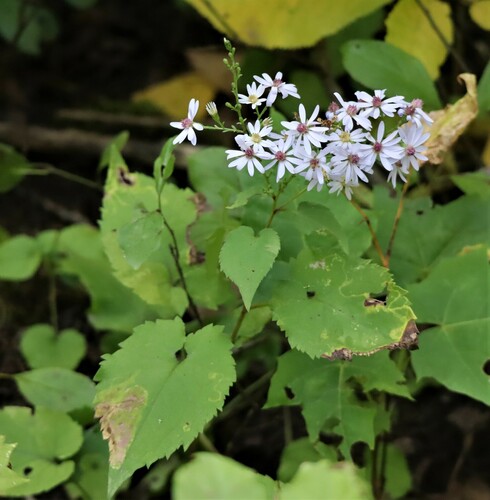
Common Blue Wood Aster
Symphyotrichum cordifolium
As the summer heat fades, the Common Blue Wood Aster transforms the forest floor into a sea of lavender-blue stars. A critical late-season nectar source, this native beauty is the heartbeat of the autumn backyard.
Quick Identification
Size
Stands 0.6–1.2 meters (2–4 feet) tall; individual flower heads are 1.3–2 cm (0.5–0.75 inches) wide.
Colors
Pale blue to lavender-violet ray petals with central discs that transition from yellow to reddish-purple; dark green foliage.
Key Features
- Distinctive heart-shaped basal leaves with serrated edges
- Masses of small, star-shaped light blue to violet flowers
- Branching, airy flower clusters (panicles) appearing in late summer
- Central flower discs that turn from yellow to burgundy after pollination
When You’ll See Them
Geographic range
Where Does the Common Blue Wood Aster Live?
Native across the central and eastern regions of North America, the Common Blue Wood Aster thrives from the southern reaches of Canada down to the Gulf Coast. Its primary range extends from the Atlantic seaboard westward to the Great Plains, where it is a common sight in the Appalachian mountains and the woodlands of the Midwest. While it is most prolific in its native North American soil, it has also been introduced to parts of Europe as a hardy ornamental garden plant.
Basemap © OpenStreetMap contributors
Behavior
The Common Blue Wood Aster is a perennial powerhouse of the late-season landscape. Unlike spring ephemerals that vanish quickly, this species spends the early summer building a robust foundation of foliage. By late August, it sends up tall, branching stems that can lean or arch under the weight of hundreds of tiny blossoms, creating a misty, blue-toned effect in the understory.
Ecologically, this plant acts as a vital social hub for the insect world. As many other nectar sources fade, the Common Blue Wood Aster becomes a primary fueling station for migrating Monarch butterflies and pre-hibernation bumblebees. It is a hardy survivor, often growing in loose colonies that spread via short rhizomes and self-seeding, making it a reliable recurring character in the backyard narrative.
EverydayEarth exclusive
Camera Tips
Capturing the Common Blue Wood Aster on a backyard camera requires a departure from standard wildlife settings. Because plants do not emit heat, they won't trigger the Passive Infrared (PIR) sensors used for mammals or birds. To document this species, switch your camera to 'Time-Lapse' mode. Set an interval of one photo every 10 to 15 minutes during the daylight hours of September and October. This will allow you to see the flowers open and close, and more importantly, catch the high-speed visits of various pollinators that are too small or fast to trigger traditional motion sensors.
For the best visual results, mount your camera on a low stake about 2 feet (0.6 meters) off the ground, angled slightly upward. This 'bug's eye view' highlights the delicate branching structure of the flower clusters against the sky. If you have a camera with a focal adjustment or macro lens, use it; the intricate detail of the central discs changing from yellow to purple is a fascinating biological clock to record.
Be mindful of the light. Wood Asters thrive in dappled shade, which can create high-contrast 'hot spots' in photos. Position your camera so the flowers are back-lit during the late afternoon; this creates a glowing 'halo' effect around the pale blue petals. If your camera is placed in a windy corridor, use a higher shutter speed if your settings allow, or move the camera closer to the main stem to minimize the blur caused by the plant swaying in the breeze.
Similar Species
Species that look similar or are commonly confused with Common Blue Wood Aster.
Frequently Asked Questions
Record Common Blue Wood Aster at your habitat
Connect a camera to start building your own species record — AI identifies every visitor automatically.