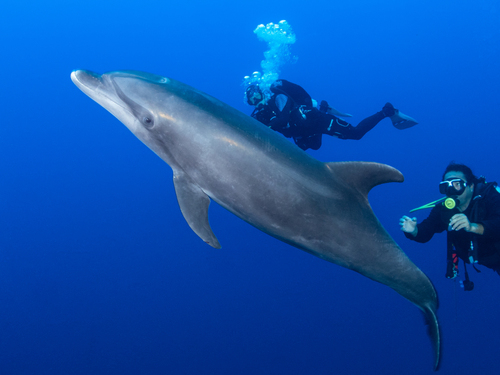
Common Bottlenose Dolphin
Tursiops truncatus
The Common Bottlenose Dolphin is the ocean's most charismatic inhabitant, known for its intelligence, signature smile, and acrobatic leaps. A resident of coastal waters worldwide, it turns every shoreline into a theater of natural wonder.
Quick Identification
Size
2 to 4 metres (6.6 to 13.1 feet) in length; weighing between 150 and 650 kilograms (330 to 1,430 pounds).
Colors
Typically dark grey on the back, fading to light grey on the sides and white or light pink on the belly.
Key Features
- Short, stubby snout called a rostrum
- High, curved dorsal fin located in the center of the back
- Stocky, powerful body build
- A distinct crease between the snout and the forehead
When You’ll See Them
Geographic range
Where Does the Common Bottlenose Dolphin Live?
Common Bottlenose Dolphins are found throughout the world's temperate and tropical oceans. They are native to every continent except Antarctica, with particularly dense populations found along the Atlantic and Pacific coasts of North America, the Gulf of Mexico, and the Mediterranean Sea. While they are primarily marine, they are frequently seen in brackish estuaries and lagoons where the water remains saline enough to support their prey.
Basemap © OpenStreetMap contributors
Behavior
Common Bottlenose Dolphins are highly social and intelligent marine mammals that live in complex social groups known as pods. These pods are often fluid, with members joining or leaving in a social structure called fission-fusion. They are famous for their sophisticated communication skills, which include a unique 'signature whistle' for each individual that acts much like a human name, allowing them to identify one another in the vast ocean.
In the wild, these dolphins exhibit remarkable problem-solving abilities and cooperative hunting techniques. They have been observed using 'bubble nets' to trap fish or even working with local fishers in certain parts of the world to drive schools of fish into nets. They are also highly playful, frequently seen leaping out of the water (breaching), riding the bow waves of boats, or surfing in the wake of large swells.
While they are generally curious about humans, they are apex predators and should be treated with respect. Their interactions with people in coastal 'backyards' are often driven by their curiosity or the search for prey. They spend a significant portion of their day foraging, socializing, and resting, with many coastal populations remaining resident in a specific home range for years.
EverydayEarth exclusive
Camera Tips
Capturing the Common Bottlenose Dolphin on an AI-powered camera requires a coastal vantage point, such as a private dock, pier, or a beachfront property with a clear view of the water. To get the best results, position your camera 5 to 10 feet above the high-tide line, angled slightly downward to catch the surface where the dolphins break for air. Because water is highly reflective, the most critical step is managing glare; if your camera supports it, use a polarized lens filter to cut through the reflection and see beneath the surface.
Lighting is a major challenge over open water. Avoid pointing your camera directly south (in the northern hemisphere) or into the sun, as this will silhouetting the dolphins and prevent the AI from identifying their markings or dorsal fins. Early morning and late afternoon provide the best 'side-lighting,' which highlights the texture of the water and the dolphin’s skin. Set your camera to a high-speed video mode or a rapid burst of photos, as dolphins move quickly and may only be above the surface for a fraction of a second.
Use the 'Activity Zone' or 'Masking' feature on your camera to ignore the repetitive motion of waves near the shore, focusing instead on the deeper channel where dolphins are likely to travel. If you live near an estuary or a narrow inlet, these are natural bottlenecks that dolphins use daily to follow schools of fish. While you should never bait dolphins with food—which is harmful and often illegal—maintaining a healthy waterfront habitat naturally attracts the fish and crustaceans that will bring dolphins right to your camera's field of view.
Similar Species
Species that look similar or are commonly confused with Common Bottlenose Dolphin.
Frequently Asked Questions
Record Common Bottlenose Dolphin at your habitat
Connect a camera to start building your own species record — AI identifies every visitor automatically.