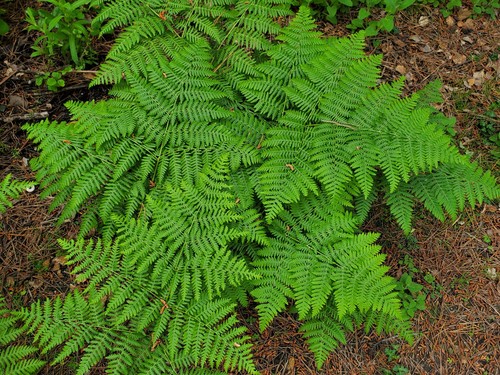
common bracken
Pteridium aquilinum
A prehistoric survivor with a global footprint, common bracken forms the emerald carpets of our woodlands. Its massive fronds provide a secret highway for backyard wildlife, offering shelter and safety to everything from songbirds to foxes.
Quick Identification
Size
Fronds typically 1–3 meters (3–10 feet) tall; can spread indefinitely via underground rhizomes.
Colors
Bright green fronds in spring and summer, turning golden-bronze or brown in autumn and winter.
Key Features
- Large, triangular three-branched fronds
- Finely divided pinnate leaflets
- Tough, woody brown stems at the base
- Underground creeping rhizomes that can extend for meters
When You’ll See Them
Geographic range
Where Does the common bracken Live?
Common bracken is one of the most widely distributed plants on Earth, claiming a truly cosmopolitan range across both the Northern and Southern Hemispheres. It is native to Eurasia and North America, where it blankets vast tracts of land from the British Isles to the Russian Far East and from Canada down through the United States into Mexico. Beyond its core northern range, it has successfully established itself in subtropical and temperate regions of South America, Africa, Australia, and New Zealand, thriving anywhere with acidic soil and sufficient moisture.
Basemap © OpenStreetMap contributors
Behavior
Common bracken is a highly successful and aggressive perennial fern that behaves more like a colonial organism than a solitary plant. It spreads primarily through an extensive network of deep, horizontal underground rhizomes, which allow it to survive fires, frosts, and surface disturbances. Once established, it can form dense, nearly impenetrable thickets that dominate the landscape, often shading out smaller native plants and inhibiting their growth through the release of allelopathic chemicals into the soil.
Ecologically, bracken plays a complex role. While it is often considered an invasive weed in agricultural contexts due to its toxicity to livestock, it provides essential habitat for various wildlife. It serves as a protective canopy for small mammals, a nesting site for ground-dwelling birds, and a food source for several specialized insect species. In the winter, the dead, standing fronds provide critical thermal insulation for animals bedding down on the forest floor.
EverydayEarth exclusive
Camera Tips
When using an AI-powered camera to monitor common bracken, the goal is usually to capture the wildlife that uses the fern for cover rather than the plant itself. Position your camera at a low height—roughly 12 to 18 inches off the ground—and aim it along the 'bracken line' where the dense thicket meets a trail or clearing. This transition zone is a high-traffic area for foxes, rabbits, and ground-nesting birds who rely on the fronds for a quick escape from predators. The dense canopy of the bracken creates a natural tunnel that animals prefer to use for stealthy movement.
Because bracken fronds are highly sensitive to wind, they can cause a significant number of 'false triggers' on PIR-based trail cameras. To mitigate this, increase your camera's trigger threshold or clear a small patch of fronds directly in front of the lens to create a clear line of sight. If your camera supports 'Time Lapse' mode, this is the best way to document the plant's incredible growth. Set the camera to take one photo every 6 hours starting in early spring; you will capture the dramatic 'unfurling' of the fiddleheads as they transform into massive green sails over just a few weeks.
Don't stop monitoring in the winter. As the bracken dies back and turns brown, it collapses into thick mats. This 'bracken litter' is a favorite bedding spot for deer. If you see a flattened patch of brown ferns in your camera's view, keep the camera active; you are likely to capture deer returning to the same warm, insulated spot night after night. For the best image quality, ensure your camera is angled slightly downward to avoid the 'white-out' effect that occurs when the camera's infrared flash reflects off the broad, flat surfaces of the fronds at night.
Similar Species
Species that look similar or are commonly confused with common bracken.
Lady Fern
Lady ferns grow in circular clumps rather than spreading carpets and have more delicate, lacy fronds.
Male Fern
Male ferns have fronds that arise from a central crown and lack the massive, three-forked branching structure of bracken.
Ostrich Fern
Ostrich ferns have vase-shaped growth and highly distinct, separate fertile fronds that look like brown feathers.
Frequently Asked Questions
Record common bracken at your habitat
Connect a camera to start building your own species record — AI identifies every visitor automatically.