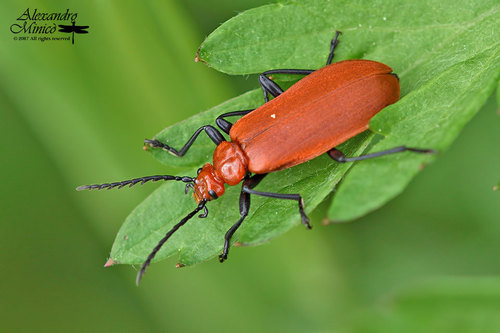
Common Cardinal Beetle
Pyrochroa serraticornis
The Common Cardinal Beetle is a vivid splash of scarlet in the early summer garden. Distinguished by its all-red head and saw-toothed antennae, this striking insect is a master of sun-drenched floral displays.
Quick Identification
Size
10–14 mm (0.4–0.55 in) in length
Colors
Bright scarlet-red head, thorax, and wing cases (elytra); jet-black legs, antennae, and underside
Key Features
- Bright red head, matching the color of the body
- Distinctive saw-like (serrated) black antennae
- Soft, flattened elytra with a slightly felt-like texture
- Large, prominent black eyes on a broad head
When You’ll See Them
Geographic range
Where Does the Common Cardinal Beetle Live?
Native to the European continent, the Common Cardinal Beetle is a common sight across the United Kingdom and Western Europe, spanning from the British Isles through France and into parts of the Mediterranean. While very similar species take over in Eastern Europe and Germany, this specific beetle is the primary 'fire-colored' resident of Atlantic-facing gardens and woodlands. It is a lowland specialist that thrives in temperate climates where managed parklands and gardens provide the perfect mix of flowers and old logs.
Basemap © OpenStreetMap contributors
Behavior
Common Cardinal Beetles are most frequently spotted during the late spring and early summer, often found basking on broad-leaved plants or feeding on the nectar of white-flowered shrubs like Hawthorn and Cow Parsley. Despite their flashy appearance, they are somewhat sluggish flyers, preferring to crawl across foliage where their bright scarlet color serves as a warning (aposematism) to birds and other predators that they contain bitter-tasting chemicals.
As adults, they are relatively solitary but may congregate in areas with high nectar availability. While they are often seen in suburban gardens, they are never far from their nursery: decaying wood. The larvae spend up to two years living under the bark of fallen trees, where they are formidable predators of other wood-dwelling insect larvae, including those of bark beetles.
EverydayEarth exclusive
Camera Tips
To capture the Common Cardinal Beetle on camera, you need to focus on 'attractor' plants. They are particularly fond of the Apiaceae family—broad, flat, white flower heads like Cow Parsley, Hogweed, or Elderberry. Position your AI-powered camera within 12 to 18 inches of these blooms, ensuring the lens is capable of macro or close-focus shots, as these beetles are relatively small. A sunny, south-facing garden border is the ideal location for high-quality, high-contrast footage of their brilliant red shells.
Because these beetles are sun-seekers, the best time to record them is during the peak heat of the day. Unlike many garden visitors that hide when it gets hot, the Common Cardinal Beetle becomes more active, crawling over the tops of leaves to regulate its temperature. If you have a woodpile or an old stump in your yard, consider placing a secondary camera there; you may catch them emerging from their larval state or searching for mates near the wood where they spent their youth.
For the best visual results, try to angle your camera so it captures the beetle's profile. This allows you to see the distinctive serrated antennae which give the species its scientific name (serraticornis). Use a high frame rate if your device allows, as their takeoff and landing on flowers can be quite sudden. Since they are not attracted to traditional lures like sugar water or fruit, focus entirely on floral placement and natural lighting.
Similar Species
Species that look similar or are commonly confused with Common Cardinal Beetle.
Frequently Asked Questions
Record Common Cardinal Beetle at your habitat
Connect a camera to start building your own species record — AI identifies every visitor automatically.