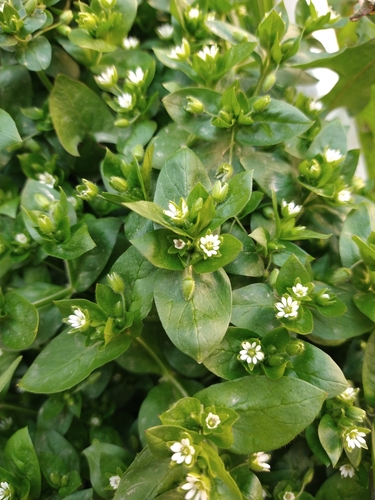
common chickweed
Stellaria media
Often dismissed as a simple garden weed, Common Chickweed is a vital ecological hero. This star-flowered groundcover provides early-season nectar for pollinators and a nutrient-dense feast for backyard birds.
Quick Identification
Size
Stems 5-50 cm (2-20 inches) long; forms mats 5-10 cm (2-4 inches) tall
Colors
Bright emerald green foliage with tiny, star-shaped white flowers
Key Features
- Single line of fine hairs running along the stem that shifts sides at each leaf node
- Five white petals so deeply notched they look like ten distinct petals
- Pairs of oval, pointed leaves that appear smooth to the touch
When You’ll See Them
Geographic range
Where Does the common chickweed Live?
Originally native to Europe and Central Asia, Common Chickweed has become one of the most successful colonizers on the planet, now naturalized across nearly every continent. It is particularly abundant throughout the United States, Canada, and the United Kingdom, where it thrives in the cool, temperate climates of suburban and agricultural landscapes. This resilient plant has followed human migration globally, establishing itself anywhere with moist, disturbed soil from the Mediterranean to the subarctic regions.
Basemap © OpenStreetMap contributors
Behavior
In the backyard ecosystem, chickweed serves as an early-season lifeline for pollinators. Its tiny flowers provide nectar for hoverflies and small bees when few other plants are in bloom. Beyond its role as a pollinator magnet, it is a favorite forage for ground-feeding birds, which rely on its high-protein seeds and nutrient-rich leaves to fuel their nesting season.
EverydayEarth exclusive
Camera Tips
To capture the intricate beauty of common chickweed, you need to think small. Because these plants grow in low, spreading mats, your AI camera should be mounted at ground level using a low-profile stake or a small flexible tripod. Position the lens 6 to 10 inches away from a cluster of healthy flowers to ensure the AI can distinguish the unique petal structure and the diagnostic line of hairs on the stem.
The most rewarding way to document chickweed is through time-lapse photography. Set your camera to capture an image every 20 minutes from dawn until dusk. This will allow you to see the flowers 'wake up' as they open to the sun and 'go to sleep' as the temperature drops in the evening. This method also increases your chances of capturing the tiny, fast-moving pollinators like syrphid flies that are often too small to trigger standard motion sensors.
If you are using the chickweed patch as a 'lure' for wildlife, aim your camera to include some of the surrounding ground. Chickweed is a magnet for ground-feeding birds like Sparrows, Finches, and Juncos. They are most active near these plants in the early morning. To get the best color saturation in your photos, avoid mid-day sun which can wash out the delicate white flowers; instead, aim for the soft, directional light of the 'golden hour' shortly after sunrise.
Similar Species
Species that look similar or are commonly confused with common chickweed.
Frequently Asked Questions
Record common chickweed at your habitat
Connect a camera to start building your own species record — AI identifies every visitor automatically.