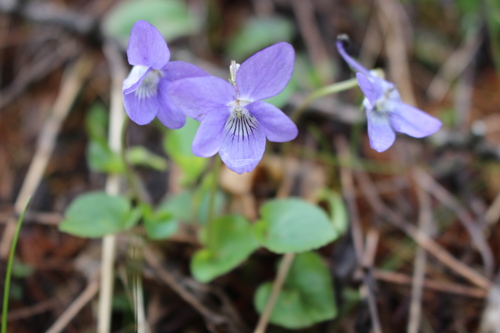
common dog-violet
Viola riviniana
The quintessential purple bloom of the spring woodland, the common dog-violet is more than just a pretty flower. It is a critical survival resource for rare butterflies and a master of clever seed dispersal.
Quick Identification
Size
Height: 5–20 cm (2–8 in); Flowers: 1.5–2.5 cm (0.6–1 in) wide
Colors
Bluish-violet petals with a distinctive pale or creamy-white spur; dark green, heart-shaped leaves
Key Features
- Heart-shaped leaves with slightly scalloped edges
- Unscented violet flowers with five petals
- A pale, notched spur that is lighter than the petals
- Small green sepals with large, pointed appendages
When You’ll See Them
Geographic range
Where Does the common dog-violet Live?
The common dog-violet is native to the temperate regions of Eurasia and parts of North Africa. It is found abundantly throughout the British Isles and mainland Europe, extending north into Scandinavia and east across Russia. While it is predominantly an Old World species, it thrives in a variety of non-acidic soil conditions across Mediterranean and temperate climates, occasionally appearing as an escapee in managed gardens outside its native range.
Basemap © OpenStreetMap contributors
Behavior
The common dog-violet is a resilient perennial that emerges in early spring, often forming dense mats of green foliage before its iconic purple blooms appear. Unlike the sweet violet, it is unscented, a trait that historically led to the 'dog' prefix, meaning 'inferior' or 'worthless' for perfumery. Despite this, it plays a vital role in the ecosystem as the primary larval food plant for several species of fritillary butterflies.
This species exhibits a fascinating method of seed dispersal known as myrmecochory. Once the flowering season ends, the plant develops three-sided seed capsules that eventually dry out and 'explode,' catapulting seeds several feet away. These seeds contain a nutrient-rich attachment called an elaiosome, which encourages ants to carry them underground into their nests, effectively planting the seeds in protected, fertilized environments.
EverydayEarth exclusive
Camera Tips
To capture the common dog-violet effectively, you must get your camera low. These plants are rarely more than a few inches tall, so mounting your AI-powered camera on a ground-level spike or a flat beanbag is essential. A 45-degree angle works best, allowing the camera to see both the heart-shaped foliage and the identifying pale spur at the back of the flower head.
If you are looking to capture the plant's role in the local ecosystem, set your camera's trigger to high sensitivity. This is the best way to record the Silver-washed Fritillary or Dark Green Fritillary butterflies as they visit the plant to lay eggs. Because these butterflies are fast-moving, ensure your camera is positioned in a spot that receives bright, dappled sunlight, which provides enough light for a fast shutter speed to freeze the action.
Time-lapse is an incredible way to observe this species. Set your camera to take a photo every hour during the peak months of April and May. This will allow you to see the 'sleep movements' of the petals, which often close slightly at night, and the eventual dramatic drying and bursting of the seed pods later in the season. For the best color accuracy, try to position your setup in a spot that avoids the harsh, direct midday sun, which can cause the violet petals to look overly blue or 'blown out' in digital images.
Finally, keep an eye on the ground activity. If your camera has a macro lens or a very close focal point, you might even capture the 'ant-transport' phase. Positioning a camera near a ripening seed pod in late June can reveal the fascinating moment when ants arrive to haul the oily seeds back to their colonies, a critical part of the common dog-violet's life cycle.
Similar Species
Species that look similar or are commonly confused with common dog-violet.
Frequently Asked Questions
Record common dog-violet at your habitat
Connect a camera to start building your own species record — AI identifies every visitor automatically.