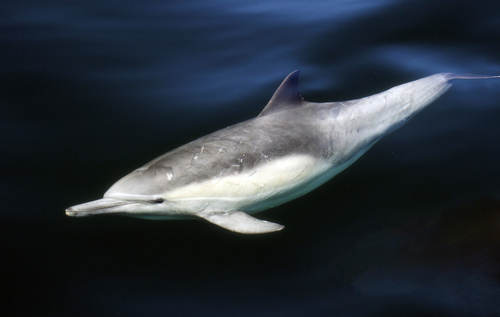
Common Dolphin
Delphinus delphis
Meet the ocean's most acrobatic voyager, the Common Dolphin. Known for their stunning hourglass patterns and massive social superpods, these energetic mammals are a masterclass in marine agility.
Quick Identification
Size
Length of 1.7 to 2.4 meters (5.6–7.9 feet); Weight between 70 and 150 kilograms (154–330 pounds)
Colors
Tri-color hourglass pattern: dark gray/black back (cape), creamy yellow front flank, and light gray tail section; white underbelly
Key Features
- Distinct hourglass pattern on the flanks
- Long, narrow beak (rostrum)
- Dark V-shaped 'saddle' directly under the dorsal fin
- Highly energetic swimmers frequently seen leaping or bow-riding
When You’ll See Them
Geographic range
Where Does the Common Dolphin Live?
The Common Dolphin is a cosmopolitan species found across the globe's temperate, subtropical, and tropical oceans. They are native to the vast expanses of the Atlantic, Pacific, and Indian Oceans, with significant populations ranging from the southern coasts of the United Kingdom and Norway down to South Africa, and from the United States and Canada across to Japan and Australia. While they primarily inhabit the deep blue of the open sea, they frequently visit coastal waters where deep-water canyons or nutrient-rich currents approach the shore.
Basemap © OpenStreetMap contributors
Behavior
Common Dolphins are among the most social and energetic cetaceans in the world. They are famous for their high-speed travel and acrobatic displays, often leaping clear of the water in a behavior known as 'porpoising.' They live in complex social structures called pods, which can range from dozens to thousands of individuals (known as superpods). These large groups are often a spectacular sight, turning the ocean surface into a frothing mass of activity as they hunt together or travel at speeds up to 60 km/h (37 mph).
In their interactions with humans, they are remarkably curious and are the species most likely to engage in bow-riding, where they surf the pressure wave created by the front of a moving ship. They communicate through a sophisticated language of clicks, whistles, and pulsed sounds, using echolocation to navigate the lightless depths or murky coastal waters. While they are generally friendly toward boats, they remain wild predators and are highly focused on their tight-knit social bonds within the pod.
EverydayEarth exclusive
Camera Tips
Capturing Common Dolphins requires a different approach than terrestrial wildlife. If you live on a coastal property with an ocean view, mount your AI-powered camera at a high elevation, such as a balcony, roofline, or a dedicated cliff-edge pole. This high vantage point maximizes your field of view and helps the AI distinguish the dolphins from the swell of the waves. Use a camera with a telephoto lens or high-quality optical zoom, as these dolphins often travel several hundred yards offshore where standard wide-angle lenses will only capture tiny specks.
Sun glare is the biggest enemy of marine photography. To avoid 'blowout' from sunlight reflecting off the water, position your camera facing away from the direct path of the sun (e.g., North-facing in the Northern Hemisphere). Using a circular polarizing filter is highly recommended, as it cuts through surface glare, allowing your camera to see the yellow and gray hourglass markings even when the dolphin is just below the surface. This also helps AI software accurately identify the species by reducing visual noise.
Set your camera to a high trigger speed with a short burst mode or continuous video recording. Because dolphins move rapidly and only surface for a second to breathe, a slow trigger will result in photos of empty water. Configure your AI detection settings to focus on movement and 'curved shapes'—this helps the system recognize the distinct falcate dorsal fin. If you are mounting a camera on a pier or dock, an underwater 'drop cam' can be incredibly rewarding, but ensure the housing is rated for saltwater and use an anti-fouling coating on the lens port to prevent algae and barnacle growth from obscuring the view.
Common Dolphins are active throughout the day, but their most dramatic hunting behaviors often occur when schooling fish are near the surface during the early morning or late afternoon. Keep an eye on local tide charts; many pods follow the tide into coastal bays or near-shore canyons. If your camera has a 'time-lapse' feature, consider running it during calm sea states (Beaufort Scale 0-2), which provides the best conditions for the AI to spot the breaks in the water surface caused by a pod's movement.
Similar Species
Species that look similar or are commonly confused with Common Dolphin.
Frequently Asked Questions
Record Common Dolphin at your habitat
Connect a camera to start building your own species record — AI identifies every visitor automatically.