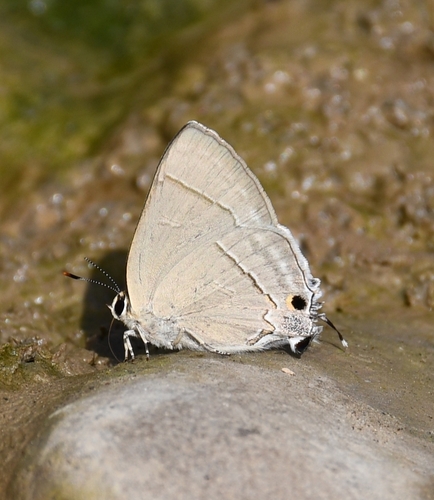
Common Flash
Rapala nissa
A metallic indigo marvel of the Himalayas, the Common Flash is a master of the 'hide and seek' game, alternating between brilliant purple displays and camouflaged earthy tones.
Quick Identification
Size
Wingspan of 30–40 mm (1.2–1.6 inches)
Colors
Males feature a deep metallic indigo or purple-blue upperside; females are predominantly dark brown. Both sexes have a greyish-brown underside with a thin white line.
Key Features
- Distinctive metallic purple sheen on male upperside
- Fine white 'flash' line on the underside of both wings
- Small orange-crowned black 'eye' spot on the hindwing lobe
- Single slender tail extending from the hindwing
When You’ll See Them
Geographic range
Where Does the Common Flash Live?
The Common Flash is a native of the majestic Himalayan mountain system and the surrounding hill tracts. Its range extends from northern Pakistan through the Indian states of Himachal Pradesh, Uttarakhand, and Sikkim, continuing into Nepal, Bhutan, and Myanmar. It is also found in the subtropical highlands of Thailand, Vietnam, and as far east as Taiwan, typically sticking to elevations where temperate forests meet tropical zones.
Basemap © OpenStreetMap contributors
Behavior
The Common Flash is a high-energy butterfly known for its rapid, erratic flight patterns. It earns its name from the way the metallic upperside of its wings 'flashes' in the sunlight before the butterfly settles and disappears against the foliage with its drab underside. Males are particularly territorial and spend much of their day guarding sunny patches from the tips of leaves, frequently engaging in aerial dogfights with other males to defend their space.
Unlike many other butterflies that wander widely, the Common Flash is somewhat sedentary once it finds a suitable habitat with its host plants. They are most active during the warmest parts of the day but will retreat to the underside of leaves during heavy rain or intense midday heat. While they are often found in the canopy, they descend frequently to find minerals and moisture.
EverydayEarth exclusive
Camera Tips
To capture the Common Flash on a backyard or trail camera, focus your efforts on 'edge' habitats where forest meets open space. These butterflies love to perch on the outermost leaves of bushes that receive direct morning sunlight. Mount your camera on a tripod at a height of 3 to 5 feet, pointing it toward a cluster of flowering shrubs or a known perching branch. Because they are small and fast, a camera with a high-speed trigger or a dedicated 'macro' mode is necessary to get a clear image.
You can significantly increase your chances of a sighting by creating a mineral lick. Find a sunny spot on the ground and keep a small patch of soil consistently damp with a mixture of water and a pinch of sea salt or well-rotted compost. The Common Flash is highly attracted to these moisture sources for essential salts. Position your camera just a foot or two from this 'puddle' for stunning close-up shots of their underside markings.
If you are using an AI-powered camera like those supported by EverydayEarth, ensure the 'small subject' or 'insect' detection settings are enabled. Since these butterflies are most active in the middle of the day, use a fast shutter speed (at least 1/1000s) to combat motion blur during their rapid take-offs. In the colder months of their flight season, look for them perching on darker rocks that retain heat, as they use these to regulate their body temperature.
Similar Species
Species that look similar or are commonly confused with Common Flash.
Frequently Asked Questions
Record Common Flash at your habitat
Connect a camera to start building your own species record — AI identifies every visitor automatically.