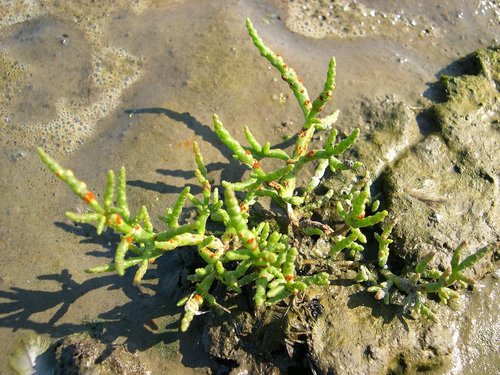
Common Glasswort
Salicornia europaea
A succulent survivor of the salt marshes, Common Glasswort paints the coastline in brilliant shades of emerald and crimson. This edible pioneer plant thrives where the land meets the sea, turning mudflats into vibrant, living tapestries.
Quick Identification
Size
Typically 5 to 35 cm (2–14 inches) in height with a branching, succulent structure.
Colors
Bright translucent green during the growing season, turning vivid crimson, orange, or purple in autumn.
Key Features
- Fleshy, jointed stems resembling miniature cacti
- Leafless appearance with scales instead of foliage
- Succulent, translucent texture
- Distinctive color shift to red in late summer
When You’ll See Them
Geographic range
Where Does the Common Glasswort Live?
Common Glasswort is native to the expansive coastal fringes of Europe, ranging from the Mediterranean Sea up to the Arctic coasts of Scandinavia and the British Isles. It is a signature species of the Atlantic and North Sea salt marshes, with significant populations found in the United Kingdom, France, and the Netherlands. While primarily a European species, it has been introduced or exists as closely related complexes in parts of North America and Asia where saline conditions persist.
Basemap © OpenStreetMap contributors
Behavior
Common Glasswort is a biological pioneer, specialized for life in the harsh intertidal zone where few other plants can survive. As a halophyte, it has evolved a unique internal chemistry that allows it to thrive in soil saturated with salt. It actually accumulates salt within its fleshy segments to maintain its water balance, a process that gives the plant its characteristic salty taste and translucent, water-heavy appearance.
Its life cycle is a race against the seasons. Germinating in the spring as tidal mudflats warm, it grows rapidly throughout the summer months. While it appears stationary, it is constantly interacting with the tides, swaying with the incoming water and providing a nursery habitat for small marine invertebrates. By late summer, it produces tiny, almost invisible flowers before undergoing a dramatic metabolic shift that turns the entire plant from green to a brilliant autumnal red.
EverydayEarth exclusive
Camera Tips
Documenting Common Glasswort with a trail camera requires a shift in strategy from traditional wildlife photography. Since the plant doesn't trigger motion sensors effectively, you should utilize your camera’s time-lapse mode. Set the interval to one photo every 30 to 60 minutes during daylight hours to capture the fascinating way the plant is submerged and then revealed by the daily tidal cycle. This also allows you to create a stunning seasonal montage of the plant’s transition from spring green to autumn crimson.
Placement is your biggest challenge in a coastal environment. You must secure your camera to a heavy-duty stake or a permanent marsh fixture, ensuring the lens is positioned about 12 inches above the mud for a dramatic 'low-profile' perspective. Check local tide tables carefully; you want the camera to be positioned where it might be splashed but not completely deep-sea diving unless you have a professional-grade waterproof housing. Aim the camera away from the direct glare of the sun reflecting off the wet mud or water, which can easily blow out your exposure.
For those interested in the 'backyard' ecosystem of the marsh, these plants are magnets for coastal birds. If you set your camera to a hybrid 'Time-Lapse + Motion' mode, you are likely to capture Redshanks, Dunlins, or even small crabs moving through the Glasswort 'forest.' To get the best color saturation, ensure your camera’s white balance is set to 'Auto' or 'Daylight,' as the rich reds of the late-season Glasswort look most spectacular under the soft light of a rising or setting sun.
Similar Species
Species that look similar or are commonly confused with Common Glasswort.
Frequently Asked Questions
Record Common Glasswort at your habitat
Connect a camera to start building your own species record — AI identifies every visitor automatically.