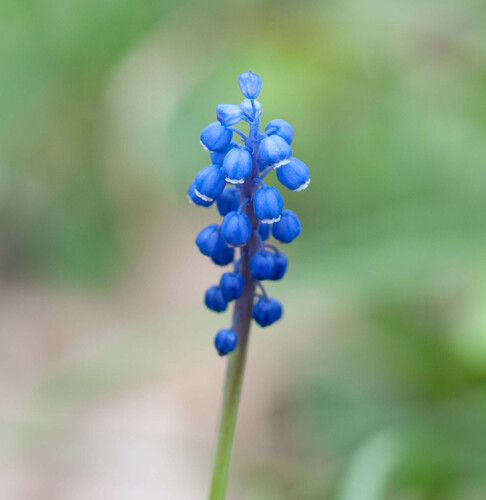
common grape hyacinth
Muscari botryoides
A miniature marvel of the spring garden, the common grape hyacinth transforms the forest floor into a sea of sapphire. Its unique grape-like clusters provide a vital early-season feast for the first pollinators of the year.
Quick Identification
Size
Height: 15–20 cm (6–8 inches); Flower clusters: 2–5 cm (0.8–2 inches) long
Colors
Deep sky-blue to violet-blue flowers; often features a delicate white rim at the mouth of the bell; bright green foliage
Key Features
- Dense, grape-like clusters of drooping, bell-shaped flowers
- Narrow, upright, strap-shaped green leaves
- Distinctive white 'teeth' or borders on the flower openings
- Low-growing, clump-forming habit
When You’ll See Them
Geographic range
Where Does the common grape hyacinth Live?
The common grape hyacinth is native to the temperate regions of Central and South-Eastern Europe, spanning from Germany and Italy eastward through the Balkans. In its native range, it is a frequent sight in alpine meadows and light woodland clearings where the soil remains moist during the spring thaw. It has since become a beloved garden escapee and has successfully naturalized across much of North America and parts of Northern Europe, where it often carpets suburban lawns and roadsides in early spring.
Basemap © OpenStreetMap contributors
Behavior
The common grape hyacinth is a spring ephemeral that brings a sudden burst of blue to the landscape as the soil warms. It follows a rhythmic seasonal cycle, emerging early in the spring from underground bulbs that store energy through the winter. Because it blooms before many larger trees fully leaf out, it takes advantage of the direct sunlight reaching the forest floor or the garden bed.
While the plant itself is stationary, it exhibits fascinating biological 'behaviors' in response to its environment. Its flowers are specifically designed to attract early-season pollinators, particularly bees and flies, which are drawn to the rich color and mild fragrance. Once pollination occurs, the plant focuses its energy on developing seed pods before the entire foliage dies back and goes dormant in the heat of mid-summer.
EverydayEarth exclusive
Camera Tips
Capturing the common grape hyacinth requires a shift in perspective. To get the best shots, place your camera at ground level. A common mistake is looking down on the plant; instead, use a small tripod or even a beanbag to prop your camera just an inch or two off the dirt. This 'worm's eye view' makes the tiny 6-inch plant look like a majestic forest of blue towers and allows you to capture the detail of the white-rimmed bells.
Because these plants are stationary, they are the perfect subjects for time-lapse photography. Set your camera to take a photo every 15–30 minutes over a period of several days in late March. When played back, you will see the 'grape' clusters slowly elongate and the individual florets unfurl. Ensure your camera is securely staked, as wind or curious squirrels can easily bump a low-profile setup.
If you are using an AI-powered camera to detect wildlife, position the hyacinths in the center of the frame to act as a 'pollinator stage.' Early spring bees and hoverflies are highly attracted to the blue pigment. By focusing on the flowers, you are likely to trigger high-quality captures of insects that are otherwise difficult to track in an open yard. Use a fast shutter speed if your camera allows, as bees move quickly between the small florets.
Lighting is crucial for these deep blue hues. The best colors are often captured during the 'golden hour' shortly after sunrise or before sunset. Direct midday sun can wash out the delicate violet tones and create harsh shadows in the dense flower cluster. If your camera has a macro mode or a close-focus setting, this is the time to use it; the texture of the waxy petals is a stunning detail often missed by the naked eye.
Frequently Asked Questions
Record common grape hyacinth at your habitat
Connect a camera to start building your own species record — AI identifies every visitor automatically.