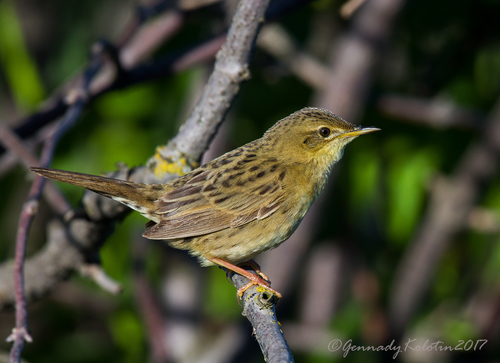
Common Grasshopper Warbler
Locustella naevia
A master of disguise and mimicry, the Common Grasshopper Warbler is more often heard than seen. Its unique mechanical song and mouse-like habits make it one of the most rewarding 'catches' for any backyard wildlife enthusiast.
Quick Identification
Size
Length: 12.5–13.5 cm (5 in); Wingspan: 15–19 cm (6–7.5 in); Weight: 11–15 g (0.4–0.5 oz)
Colors
Upperparts are olive-brown with dark brown streaks; underparts are pale yellowish-buff or off-white with fine spotting on the throat and breast; pinkish-brown legs.
Key Features
- Distinctive mechanical reeling song like a grasshopper
- Secretive, mouse-like movement through dense vegetation
- Pale-edged tail feathers with rounded tip
- Strongly streaked olive-brown mantle
When You’ll See Them
Geographic range
Where Does the Common Grasshopper Warbler Live?
Native to the temperate regions of Europe and the Western Palearctic, the Common Grasshopper Warbler is a long-distance traveler that spans multiple continents. Its breeding grounds stretch from the United Kingdom and Iberia across Central Europe into Western Siberia. During the autumn, these birds migrate south to spend the winter months in the lush wetlands and scrub of northern tropical Africa, with smaller populations wintering in India. While they are widespread across Europe, they are highly localized, appearing only where thick, undisturbed ground cover is available.
Basemap © OpenStreetMap contributors
Behavior
The Common Grasshopper Warbler is one of the most elusive summer visitors to the Palearctic. Often described as 'mouse-like,' it rarely flies in the open, preferring to scurry through thick grass, reeds, and scrub rather than hopping between branches. Its most famous trait is its song—a monotonous, high-pitched mechanical trill that can last for several minutes without a break, often leading observers to mistake it for an insect like a grasshopper or cricket.
During the breeding season, males are most active at dawn and dusk, when they climb to a slightly elevated but still concealed perch to deliver their reeling song. They are solitary and highly territorial, though their presence is almost entirely detected by ear rather than by sight. When disturbed, they tend to drop silently into the undergrowth rather than taking flight.
EverydayEarth exclusive
Camera Tips
Capturing the Common Grasshopper Warbler on camera is a masterclass in patience and positioning. Because these birds rarely fly and instead 'crawl' through the grass, you must place your AI camera very low to the ground, no higher than 30 to 50 centimeters. Aim the lens toward small natural openings in thick scrub or along the 'runs' they create in tall grass. Avoid wide-open areas; these birds feel vulnerable in the clear and will almost always stick to the shadows of dense vegetation.
To trigger a recording, use a high-sensitivity motion setting and a fast trigger speed. Because their movements are subtle and mouse-like, a camera with a high frame rate (60fps) is ideal for capturing the fast twitching of their tail and the vibration of their throat while reeling. Since they are most active during the low-light hours of dawn and dusk, ensure your camera has excellent low-light performance or a subtle infrared flash that won't startle them.
While traditional bird feeders won't work for this insect-eater, you can increase your chances by placing your camera near a shallow, natural-looking water source or a damp patch of ground where insects congregate. If you can locate a male's 'reeling perch'—usually a slightly taller stalk of grass or a low bramble branch—position your camera with that perch in the center of the frame. The peak recording window is late April and May when males are most vocal and active in establishing territories.
Similar Species
Species that look similar or are commonly confused with Common Grasshopper Warbler.
Frequently Asked Questions
Record Common Grasshopper Warbler at your habitat
Connect a camera to start building your own species record — AI identifies every visitor automatically.