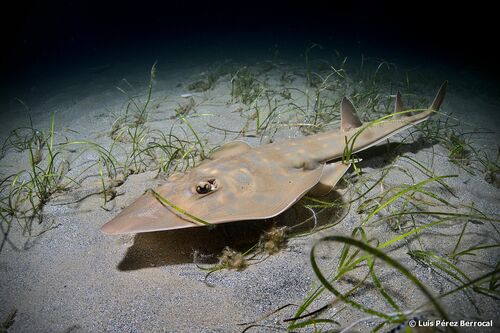
Common Guitarfish
Rhinobatos rhinobatos
Meet the 'Shovelnose' of the shallows. The Common Guitarfish is a fascinating bridge between sharks and rays, hiding in plain sight along the sandy shores of the Mediterranean.
Quick Identification
Size
Typically 80–100 cm (31–39 inches) in length, with a maximum of 147 cm (58 inches); they generally weigh between 10–20 kg (22–44 lbs).
Colors
Upper body is khaki, olive-brown, or reddish-brown; underside is a uniform creamy white or pale yellow.
Key Features
- Flattened, wedge-shaped head forming a triangular disc
- Two large, shark-like dorsal fins located behind the pelvic fins
- Powerful tail used for swimming, unlike the flapping motion of most rays
- Narrow snout without the black blotch found in similar species
When You’ll See Them
Geographic range
Where Does the Common Guitarfish Live?
Native to the eastern Atlantic Ocean and the Mediterranean Sea, the Common Guitarfish is most frequently found from the southern Bay of Biscay down to the coast of Angola. While once widespread across the entire Mediterranean basin, its core populations are now primarily concentrated in the southern and eastern sectors, particularly around Tunisia and Turkey. It is a strictly coastal specialist, rarely venturing beyond the edges of the continental shelf.
Basemap © OpenStreetMap contributors
Behavior
The Common Guitarfish is a master of coastal camouflage, spending much of its day partially buried in sandy or muddy substrates. By undulating its pectoral fins, it settles into the sediment until only its eyes and spiracles (breathing holes) are visible. While they appear sedentary, they are capable of explosive bursts of speed to ambush passing prey or evade larger sharks.
Unlike many other rays that 'fly' through the water by flapping their wings, the Common Guitarfish swims using lateral thrusts of its thick, muscular tail, much like a shark. They are primarily solitary hunters but are known to congregate in shallower waters during the summer months for mating and to give birth to live young. They are generally non-aggressive toward humans but are highly sensitive to vibrations and shadows.
EverydayEarth exclusive
Camera Tips
Capturing a Common Guitarfish on camera requires specialized underwater equipment, making it a thrilling challenge for coastal residents. For the best results, use a weighted 'drop-cam' or a pier-mounted underwater housing positioned 12 to 18 inches above a sandy seabed. Use a wide-angle lens and tilt the camera slightly downward (about 15 degrees) to capture the unique 'shovelnose' profile as they glide across the bottom.
Attracting these shy elasmobranchs is best achieved using scent rather than visual lures. Secure a mesh bait bag or a perforated PVC tube filled with oily fish—such as crushed sardines or mackerel—directly in front of the camera lens. Place the bait about 3 feet away to ensure the fish stays in focus. Rising tides are the ideal time for recording, as the moving water helps disperse the scent trail along the coastline, drawing the guitarfish toward your setup.
Because they are perfectly camouflaged, video is far superior to still photos for identification. Record in 4K resolution at 60 frames per second; this high frame rate allows you to see the subtle 'breathing' movements of their spiracles or the puff of sand they create when they settle. If your camera supports it, use red-filtered LEDs for night recording, as standard white light can cause a strong flight response, scaring the guitarfish away before you get a clear shot.
Similar Species
Species that look similar or are commonly confused with Common Guitarfish.
Frequently Asked Questions
Record Common Guitarfish at your habitat
Connect a camera to start building your own species record — AI identifies every visitor automatically.