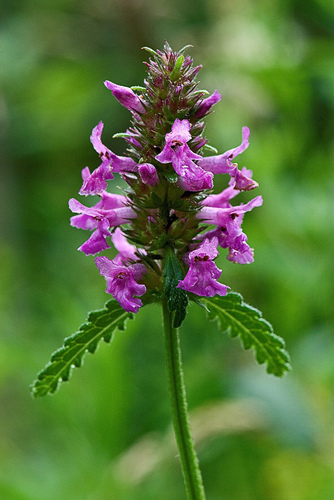
common hedge-nettle
Betonica officinalis
A staple of the ancient European hedgerow, the common hedge-nettle offers a splash of royal purple to any wild space. This pollinator powerhouse is as famous for its history in medieval herbalism as it is for its stunning, nectar-rich floral displays.
Quick Identification
Size
Grows to a height of 30–60 cm (12–24 in) with a spread of approximately 30 cm (12 in).
Colors
Deep magenta to purple-pink tubular flowers; dark green crinkled foliage.
Key Features
- Spikes of densely packed two-lipped purple flowers
- Wrinkled, heart-shaped basal leaves with rounded teeth
- Square stems characteristic of the mint family
- Upright, clump-forming growth habit
When You’ll See Them
Geographic range
Where Does the common hedge-nettle Live?
This resilient perennial is native across the vast temperate reaches of Europe, extending into western Asia and northern Africa. Within its core range, it is a common sight in the British Isles and mainland Europe, thriving in traditional hay meadows and sunny forest clearings. While it remains most prolific in its native Eurasian soil, it has been successfully introduced to parts of North America as an ornamental garden plant, where it occasionally naturalizes in suburban environments.
Basemap © OpenStreetMap contributors
Behavior
As a perennial herb, common hedge-nettle is a reliable fixture in late-summer landscapes. It begins the growing season as a lush rosette of crinkled green leaves, eventually sending up stiff, square stalks topped with vibrant floral spikes. Unlike many of its more aggressive mint relatives, it remains in tidy clumps rather than spreading uncontrollably through rhizomes, making it a favorite for structured wild gardens and meadow restoration projects.
This plant serves as a vital hub for local biodiversity. Its nectar-rich flowers are specifically shaped to accommodate long-tongued bees, including bumblebees and various moths. Historically, humans held this plant in high regard as a 'cure-all' in medieval medicine—earning it the name Bishop’s Wort—though today its primary interaction with people is as a beautiful ornamental and a magnet for backyard pollinators.
EverydayEarth exclusive
Camera Tips
Capturing common hedge-nettle on an AI-powered camera is less about the plant's movement and more about the 'pollinator highway' it creates. To get the best results, position your camera on a small tripod or ground-stake just 12 to 18 inches off the floor, aiming slightly upward at the flower spikes. This low angle captures the architectural beauty of the blooms against the sky and ensures you are at eye-level with the bees and butterflies that visit.
Since this species is a favorite for bumblebees and clearwing moths, set your camera to 'Burst Mode' or high-speed video. AI cameras often trigger based on the movement of the visitors rather than the plant itself. To maximize these captures, ensure the camera is facing south or east to take advantage of the morning sun; this is when nectar production is at its peak and insect activity is highest. Ensure your focus is locked on the flower head to avoid the camera focusing on background grass.
If your camera supports time-lapse features, common hedge-nettle is a fantastic subject for a summer-long project. Set the camera to take one photo every 6 hours starting in late May. You’ll be able to document the dramatic transformation from a flat green rosette to a towering purple spire. Avoid using heavy baits or lures near the plant; instead, ensure the area is well-watered during dry spells to keep the nectar flowing, which naturally draws in the wildlife you want to photograph.
Similar Species
Species that look similar or are commonly confused with common hedge-nettle.
Frequently Asked Questions
Record common hedge-nettle at your habitat
Connect a camera to start building your own species record — AI identifies every visitor automatically.